Back in 2008, when Marvel's Amazing Spider-Man switched to a thrice-monthly publication schedule, I did a little math to figure out when the numbering of ASM would catch up with that of DC's Action Comics. Assuming continued thrice-monthly publication for ASM and monthly for Action, I determined that it would be in January 2020 with issue #1016.
But as it turns out, that's never going to happen. At some point ASM swtiched to twice-monthly publication, which would have slowed down the progression. But then last year DC cancelled all of their DCU titles and started everything over at issue #1, including the long-running Action. And now Marvel is cancelling Amazing with issue #700.
I suppose it's possible that at some point in the future DC will revert to the old numbering scheme for their titles. And I'd imagine that Marvel will at some point resurrect Amazing (I give it maybe a year...) If those scenarios happen (and if this blog is still around...) we'll recalculate.
Showing posts with label analysis. Show all posts
Showing posts with label analysis. Show all posts
Wednesday, October 24, 2012


Tuesday, August 30, 2011
Success Metrics for the new DCU

(Note that I am considering success from the publisher's perspective in this post. For we readers, success will and should be determined by quality of the comics themselves.)
Profit. Actually, the chance of making a profit from the venture is slim at best. But that's okay, as profit isn't the main motivator for DC anyway. Oh sure they'd be happy if all of their titles were making money, but I suspect they'll be perfectly happy with simply losing less money overall, especially if some of the other metrics are met.
Sales. Obviously, increasing sales is one of DC's main goals. This could be measured in many ways, e.g. by increase in individual titles that are being relaunched, or the number of the 52 titles over a certain threshold. But as this is a complete line-wide revamp, perhaps the most salient number to look at will be the average sales of the entire DCU line. Courtesy of The Beat, here's a table of the line-wide averages for the DCU as of this past June's sales figures:
DC UNIVERSE
06/2006: 53,274
06/2007: 47,986
06/2008: 35,800
06/2009: 36,329
---------------
06/2010: 34,612 (- 7.6%)**
07/2010: 35,372 (+ 2.2%)
08/2010: 33,411 (- 5.5%)
09/2010: 32,042 (- 4.1%)
10/2010: 32,832 (+ 2.5%)
11/2010: 34,180 (+ 4.1%)
12/2010: 30,870 (- 9.7%)
01/2011: 24,321 (-21.2%)**
02/2011: 25,887 (+ 6.4%)**
03/2011: 26,720 (+ 3.2%)**
04/2011: 29,126 (+ 9.0%)
05/2011: 27,745 (- 4.7%)**
06/2011: 28,673 (+ 3.4%)**
----------------
6 months: - 7.1%
1 year  : -17.2%
2 years : -21.1%
5 years : -46.2%
Notice a trend? Even the two-year comparison is bad, and the five-year number is atrocious. Now part of that five-year decline can be attributed to DC pumping out even more low-selling titles; one sure way of raising the line-wide average would be to cut out all of the low-selling titles and publish fewer comics. But since DC seem determined to publish 52 monthly titles (or more, with additional mini-series coming starting in October...), getting the line-wide average as it stands a year from now up to at least where it was in 2009 would be considered a win.
Market Share. Despite DC's claims to the contrary, I believe that a market share win against their cross-town rivals at Marvel will be considered a victory. Market share is one of the things you can trumpet even when you are not actually making money. And if market share wasn't a top concern, there would be no reason to be pumping out so many new comics every month, most of which are losing money and whose only purpose seems to be taking retail shelf space away from your competitors. It seems highly likely that DC will see a market share win in September; if they can keep that going for a majority of the coming twelve months—or at least keep it more competitive than it has been in the recent past—they will consider the New 52 a success.
Digital Sales. With the day-and-date availability of digital versions of all of the DCnU titles, DC is obviously hoping to pick up new readers who are willing to pay for online comics. To date, digital sales on most comics have been a small fraction of the print sales, due to: 1) inconsistent availability; 2) the gawdawful hard-to-use old comiXology app (a new revised version was released last week, and based on my initial few minutes of testing it appears to be vastly improved); and 3) competition from cost- and DRM-free illegal scans. With all of the DCnU titles now available online on a consistent basis, they should see an upswing in the number of people buying online. The question is how big that upswing will be? I don't imagine that the number of people who are willing to pay the parity-with-print $2.99 cost for the digital comics in their first month of release will be huge; but there may be enough people willing to cough-up the month-old $1.99 price for titles to make up for any deficiencies in the sales of print.
Visibility. The real business of DC Comics, as far as their corporate overlords are concerned, is in generating characters and other intellectual property that can be exploited for profit in other media. Not just blockbuster movies like The Dark Knight, but in video games, television, licensed apparel, etc. So every time a story about the DCnU hits the comic press, or especially the mainstream press, it is a win for DC. Even if all of the other metrics we've discussed are moderate at best, the amount of publicity already generated is likely being viewed as a success.
Long Term. It will be tempting to look at the first-month sales figures for the DCnU titles and make a snap judgment about the New 52's success. But the real measure won't be apparent until at least a year, or even better two years, down the line. How many of the New 52 are still being published in 2013? Will the "cancellation floor" for the line as a whole rise? Can titles maintain their initial sales boost? Will DC be able to successfully launch new comics and properties? Answers to these kinds of questions will ultimately tell us if this big experiment has really succeeded.
Tuesday, January 18, 2011
Amazon Top 50 of 2010: Graphs
It's a little later than I promised, but here are a few graphs looking at the position of some series on the Amazon Top 50 charts during 2010:
(You should be able to click on a graph to get a larger version.)
(Remember, a title in position 1 on the chart gets a score of 50, so higher number = higher on the graph = better.)
Scott Pilgrim:

This graph is fairly typical for a franchise with a movie based on it. Interest in Scott Pilgrim starts in March, then intensifies in June. Unfortunately, June is also when Amazon decides to reclassify vols 4 & 5 as not being graphic novels for a time. A sizable discount keeps interest high through the autumn, until November when prices return to normal Amazon levels and interest softens a bit.
Diary of a Wimpy Kid:
 This graph is for the raining king of Amazon graphic novels, Diary of a Wimpy Kid.This was another franchise that was a victim of an Amazon reclassification, as three of the titles disappear in late April. Volume 5 was introduced as a pre-order in March, and by August it was ensconced at the top of the chart where it has stuck around ever since.
The Walking Dead:
 The Walking Dead got a big boost from the television series. Unlike our previous two franchises, there are many more collected volumes and many more ways of purchasing the same story (trade paperbacks, hardcovers, and the compendium). Thus we see the growing interest taking the form of a greater density of titles on the chart, even as no single volume ever dominates.
Maus:
 Finally here's Maus. Even with its collected editions over twenty years old, it gets periodic interest in January and September due to its widespread use as a text in college courses.
(You should be able to click on a graph to get a larger version.)
(Remember, a title in position 1 on the chart gets a score of 50, so higher number = higher on the graph = better.)
Scott Pilgrim:

This graph is fairly typical for a franchise with a movie based on it. Interest in Scott Pilgrim starts in March, then intensifies in June. Unfortunately, June is also when Amazon decides to reclassify vols 4 & 5 as not being graphic novels for a time. A sizable discount keeps interest high through the autumn, until November when prices return to normal Amazon levels and interest softens a bit.
Diary of a Wimpy Kid:

The Walking Dead:

Maus:

Tuesday, May 25, 2010
What the CMX Shuttering May Tell Us About the Future of Comics Publishing at DC
 Last week's abrupt ending to DC's CMX manga line really should come as no surprise. It was always the bastard stepchild of the DC publishing family; a sub-imprint of an imprint (WildStorm) that is headquartered across the country. One imagines that the manga line was originally developed because the powers-that-be at DC saw that manga was becoming popular, and so maybe they should dip their toes in the water and see what the what was.
The only surprises about CMX closing down are a) the suddenness of it all; and b) that it took so long to happen. Most likely once Diane Nelson found out about its existence and figured out that it wasn't making any money, it was very quickly axed.
CMX never really fit in with DC before the creation of DC Entertainment, and it certainly doesn't fit in now. I've made the point previously that DC (and for that matter Marvel) are not in the business of making money from publishing comic books. Nor for that matter are they in the business of trying to get comic books into the hands of underserved readers. No, DC are in the business of exploiting their intellectual property through movies, television, licensing, etc.
Viewed in this light, the decision to shutter CMX was a no-brainer for the DCE suits. Since these were properties that DC was licensing from other entities in order to publish them, there was no chance that they could make any money off of any other exploitations. Should a movie get made based on From Eroica with Love or Emma, DCE wouldn't see one thin dime. (Sure they may see some uptick in sales of the manga, but except in an exceptional case that would not result in much revenue.)
So given this new attitude, what other moves can we expect to see in the coming months?
Look for WildStorm to stop licensing properties from movies and tv to make comics. These sorts of comics rarely sell well these days, and they fall under the same non-exploitable category as manga. There may be an exception for Warner-owned properties like Supernatural. And it's likely that DC Kids will continue to publish comics based on Looney Tunes & the various Cartoon Network shows, if only to keep a nominal toe in the comics publishing waters for those Warner-owned items. First Wave? Sales are very soft, so if it makes it out of the year I'll be surprised. Certainly when the various licenses come up for renewal I doubt there will be much reason to maintain them.
In fact, I would wager that WildStorm itself will find its days numbered. I don't think it will fall right away; Jim Lee's position as co-publisher will protect it somewhat. (If Lee had been a champion of CMX, it might have had a more graceful exit...) But when it comes right down to it there's no good reason to have a separate west coast comics publishing arm. The traditional WildStorm properties (Wildcats, Gen13, The Authority, etc.) haven't been commercial or critical successes in a long time; licensed comics days are numbered; and outside of Ex Machina (whose ending is nigh) they haven't had a creator-owned success lately either.
Speaking of creator-owned properties, their days are probably numbered as well. While I believe that most creator-owned works published by DC/WildStorm/Vertigo do have some degree of profit participation for the publisher should the work end up being exploited in other media (and likely Warner has some sort of right of first refusal for producing such things), given DCE's new explicit focus I suspect that they will opt to concentrate on properties for which they would get full participation. So unless you happen to be a creator who is also working on their mainstream company-owned titles and they want to keep you happy (e.g. your name is Grant Morrison), don't expect WildStorm or Vertigo to be terribly welcoming for your creator-owned comics in the future.
And where does this leave Vertigo? I suspect that the imprint will remain for a while. I suspect that existing creator-owned comics will be allowed to stay as long as they aren't losing a lot of money (i.e. Fables is probably safe for the time being), but new creator-owned comics will be few. With creator-owned projects likely being phased out, look for Vertigo to concentrate on the other half of their imprint, which if revamping musty DC-owned properties for an adult (or at least adult-ish) audience. Such new projects will still be tried, but if they don't catch fire don't look for even many of those to last beyond two years. You only need a handful of collected editions to make a suitable pitch for a movie or television series. So for the future of Vertigo, look towards Unknown Soldier.
In the final analysis then, what will DC Comics be up to? Publishing comics based on their existing catalog of characters. Quality, it should be noted, doesn't really matter in the equation. As long as there are comics on the racks that feature Superman, Batman, Wonder Woman, Green Lantern, etc., then the comics are doing their job of keeping those properties in the comic-buying consumer's consciousness until the next movie or tv show comes out. Expect the comics to be increasingly driven by top-down editorial mandate.
We might still get some good comics. I enjoy Jonah Hex most months, even though its continued existence is mainly due to the upcoming movie (and to some extent Dan Didio's reported soft spot for the character). But unless your comic maintains a minimal sales level, or has a champion at the VP level, or has been optioned for a movie, don't expect it to last for long in its present form.
Prices? DC is quietly instituting the Marvel-esque $4 for a standard comic, or at least testing the waters. I'll have another post about that in the (near?) future...
Tuesday, August 25, 2009
Could Digital Comics Save the Midlist?
I was contemplating this morning the coming wave of digital comics. (And by digital comics I don't mean Webcomics—those that are born online—but rather digital editions of print comics.)
It's no secret that the past decade or so has not been kind to the midlist in the direct market. A system has evolved by which the major publishers are chasing the hits with splashy first month sales. As in other media (films, books, music) this serves to depress sales of midlist titles, making it very hard for a comic series to have a long life selling in the middle of the pack. And you almost never see a comic series have a nice regular upward growth in sales.
It occurs to me that a couple of different digital comics models could be a boon to midlist titles.
The first, the "iTunes model" that is nearly imminent with Longbox, could results in long tail effects being realized. This would especially be a boon to smaller publishers that aren't picked up by a majority of comics shops, as they would have a way to point their widely dispersed potential audience to an online location for purchase. Since marginal costs for distributing digital comics is close to zero and "shelf space" is virtual, such comics can potentially find their audience much more easily,
The second, a subscription model, would potentially be more helpful for midlist titles at major publishers. An analogue for this is cable television subscription channels such as HBO or Showtime. These networks are selling a package to viewers, not individual programs. This means that a critically acclaimed title adds to the overall package and is not viewed in terms of opportunity costs lost by not doing the next big crossover event. (In an interview I recently heard with the head of documentary programming for HBO, she said that in her 30 years with the network no one had ever even gone over ratings with her!)
I for one want a comic market that can support a title like Nexus and that can nurture the next Bone.
It's no secret that the past decade or so has not been kind to the midlist in the direct market. A system has evolved by which the major publishers are chasing the hits with splashy first month sales. As in other media (films, books, music) this serves to depress sales of midlist titles, making it very hard for a comic series to have a long life selling in the middle of the pack. And you almost never see a comic series have a nice regular upward growth in sales.
It occurs to me that a couple of different digital comics models could be a boon to midlist titles.
The first, the "iTunes model" that is nearly imminent with Longbox, could results in long tail effects being realized. This would especially be a boon to smaller publishers that aren't picked up by a majority of comics shops, as they would have a way to point their widely dispersed potential audience to an online location for purchase. Since marginal costs for distributing digital comics is close to zero and "shelf space" is virtual, such comics can potentially find their audience much more easily,
The second, a subscription model, would potentially be more helpful for midlist titles at major publishers. An analogue for this is cable television subscription channels such as HBO or Showtime. These networks are selling a package to viewers, not individual programs. This means that a critically acclaimed title adds to the overall package and is not viewed in terms of opportunity costs lost by not doing the next big crossover event. (In an interview I recently heard with the head of documentary programming for HBO, she said that in her 30 years with the network no one had ever even gone over ratings with her!)
I for one want a comic market that can support a title like Nexus and that can nurture the next Bone.
Wednesday, June 24, 2009
How Publishers Discourage You From Buying Single Issues of Their Comics
Exhibit #1: Boom! Studio's Irredeemable: Volume 1 collects issues #1-4 of the series.
* Cost to buy the individual issues (at $3.99 each): $15.96.
* Cost to buy the collection: $9.95
* Your penalty for buying the individual issues: $6.01
Exhibit #2: DC/Vertigo's Madame Xanadu Vol. 1: Disenchanted collects issues #1-10 of the series.
* Cost to buy the individual issues (at $2.99 each): $29.90
* Cost to buy the collection: $12.99
* Your penalty for buying the individual issues: $16.91
(plus there are no ads in the collection!)
When readers know there's going to be a cheaper collection soon after the issues in it are published, why should they shell out the $$$$ for the individual issues?
* Cost to buy the individual issues (at $3.99 each): $15.96.
* Cost to buy the collection: $9.95
* Your penalty for buying the individual issues: $6.01
Exhibit #2: DC/Vertigo's Madame Xanadu Vol. 1: Disenchanted collects issues #1-10 of the series.
* Cost to buy the individual issues (at $2.99 each): $29.90
* Cost to buy the collection: $12.99
* Your penalty for buying the individual issues: $16.91
(plus there are no ads in the collection!)
When readers know there's going to be a cheaper collection soon after the issues in it are published, why should they shell out the $$$$ for the individual issues?
Wednesday, June 18, 2008
Batman RIP Sells
Disclaimer: obsessing over Diamond Sales Figures is bad for your health, bad for comics, and most likely contributes to global warming.
Lost in all the hubbub over the fact that Final Crisis #1 fell short of Secret Invasion #2 (though I'll get to that in a moment...) is that fact that the first 2 chapters of "Batman R.I.P" sold surprisingly well, right up at the 100,000 mark. Whatever disappointment DC might be feeling over Final Crisis numbers should be tempered a bit by this fact.
I'd chalk up the good sales on "Batman R.I.P." to the confluence of: Batman fans + Morrison fans + Tony Daniel fans + Big-ish Event fans + pre-Dark Knight movie excitement. "Batman R.I.P." could trn out to be this year's "Sinestro War"; maybe DC will learn that these minor-sized big-ish events will work for a better long-term strategy than the massive Crisis crossovers.
The other big sales surprise was the strong showing for Avengers/Invaders #1, proving that just about anything that Alex Ross is involved in is Direct Market gold.
As for the Final Crisis numbers: it's debuting at about 100,000 units less than Infinite Crisis did, which has to be disappointing. This is the first time that Marvel & DC have had their big event crossovers go head-to-head, so there was bound to be an effect. (We should also note that FC came out the last week of the month, so there are no re-order numbers included in the total, while SI came out the first week of the month so there is like a boost from re-orders there.)
It will be interesting to see the June figures: will Final Crisis take the same size drop that Secret Invasion did? Will Batman remain strong? How will Trinity do? (I think it was a mistake to start the weekly Trinity at the same time as Final Crisis; they each draw attention away from the other, and an eight-month break between weekly series was warranted.)
Lost in all the hubbub over the fact that Final Crisis #1 fell short of Secret Invasion #2 (though I'll get to that in a moment...) is that fact that the first 2 chapters of "Batman R.I.P" sold surprisingly well, right up at the 100,000 mark. Whatever disappointment DC might be feeling over Final Crisis numbers should be tempered a bit by this fact.
I'd chalk up the good sales on "Batman R.I.P." to the confluence of: Batman fans + Morrison fans + Tony Daniel fans + Big-ish Event fans + pre-Dark Knight movie excitement. "Batman R.I.P." could trn out to be this year's "Sinestro War"; maybe DC will learn that these minor-sized big-ish events will work for a better long-term strategy than the massive Crisis crossovers.
The other big sales surprise was the strong showing for Avengers/Invaders #1, proving that just about anything that Alex Ross is involved in is Direct Market gold.
As for the Final Crisis numbers: it's debuting at about 100,000 units less than Infinite Crisis did, which has to be disappointing. This is the first time that Marvel & DC have had their big event crossovers go head-to-head, so there was bound to be an effect. (We should also note that FC came out the last week of the month, so there are no re-order numbers included in the total, while SI came out the first week of the month so there is like a boost from re-orders there.)
It will be interesting to see the June figures: will Final Crisis take the same size drop that Secret Invasion did? Will Batman remain strong? How will Trinity do? (I think it was a mistake to start the weekly Trinity at the same time as Final Crisis; they each draw attention away from the other, and an eight-month break between weekly series was warranted.)
Wednesday, March 19, 2008
When Will Amazing Spider-Man Catch Up with Action Comics?
 Now that Amazing Spider-Man is being published three times a month, when will it catch up in its numbering to Action Comics?
Assuming that ASM keeps its thrice-monthly publication, and that Action continues to come out once a month (not a guarantee, especially lately...), we can do a little quick back-of-the-napkin algebra:
Issue #554 of ASM is the last one published in March; Action didn't publish an issue in March (see what I mean!) though #862 came out in February. So, let x = the number of months until the two titles reach numbering parity, and we get:
554 + 3x = 862 + X
2x = 308
x = 154
So in 154 months; or 12 years, 10 months from now; i.e. January 2020, with issue #1016.
This has been your useless comics math calculation of the day :)
Friday, January 25, 2008
Women Creators at Marvel & DC (and Image & Dark Horse)
David Welsh's recent post about tips for media writers when writing about female comic creators got me to thinking: just how many women are writing or drawing comics at the major pop comics publishers?
Let's go counting through the April solicits!
(Note: I'm not counting manga or OGNs.)
Marvel:
Writers: 2: Robin Furth on Dark Tower & Lords of Avalon; Jessica Ruffner on Anita Blake.
Artists: 1: Adriana Melo on Ms. Marvel.
DC:
Writers: 2: Amy Wolfram on Teen Titans Year One; Gail Simone on Wonder Woman & Welcome to Tranquility
Artists: 2: Nicola Scott on Birds of Prey; Sandra Hope on World of Warcraft
Image:
Writers: none
Artists: 1: Laura Allred on Madman Atomic Comics
Dark Horse:
Writers: none
Artists: 1: Jan Duursema on Star Wars: Legacy
So as far as creator gender representation in mainstream comics goes, things are no better than they were ten, twenty or thirty years ago--the days of Louise Simonson, Jo Duffy, Ann Nocenti, June Brigman, Marie Severin, Ramona Fradon, etc.
One might think that, with more titles being pushed out these days, there would be opportunities for more creators, and that some of those slots would be filled by women creators.
It's hard to address the why of the gender imbalance without speaking in supposition and generalities. I think that there are a combination of factors at work, some of which boil down to a lack of desire on the part of female creators to work on corporate super-hero comics when there are plenty of other avenues available for their creative expression.
(1/28: Edited, 'cause I totally spaced and left off Jan Duursema.)
Let's go counting through the April solicits!
(Note: I'm not counting manga or OGNs.)
Marvel:
Writers: 2: Robin Furth on Dark Tower & Lords of Avalon; Jessica Ruffner on Anita Blake.
Artists: 1: Adriana Melo on Ms. Marvel.
DC:
Writers: 2: Amy Wolfram on Teen Titans Year One; Gail Simone on Wonder Woman & Welcome to Tranquility
Artists: 2: Nicola Scott on Birds of Prey; Sandra Hope on World of Warcraft
Image:
Writers: none
Artists: 1: Laura Allred on Madman Atomic Comics
Dark Horse:
Writers: none
Artists: 1: Jan Duursema on Star Wars: Legacy
So as far as creator gender representation in mainstream comics goes, things are no better than they were ten, twenty or thirty years ago--the days of Louise Simonson, Jo Duffy, Ann Nocenti, June Brigman, Marie Severin, Ramona Fradon, etc.
One might think that, with more titles being pushed out these days, there would be opportunities for more creators, and that some of those slots would be filled by women creators.
It's hard to address the why of the gender imbalance without speaking in supposition and generalities. I think that there are a combination of factors at work, some of which boil down to a lack of desire on the part of female creators to work on corporate super-hero comics when there are plenty of other avenues available for their creative expression.
(1/28: Edited, 'cause I totally spaced and left off Jan Duursema.)
Tuesday, January 22, 2008
Diamond 2007 Chart Position and Sales
Near the end of his discussion on the ICv2 Diamond Sales Estimates for December, Tom Spurgeon remarks:
Ask and ye shall receive, Tom!
I looked at ICv2's Sales Estimates charts for all of 2007, grabbing the sales figures for positions 1, 10, 50, 100, 150, 200, 250, and 300. (I also did the graphic novel charts for positions 1, 10, 50, and 100.) Here's what we get:

(The Y-axis on the chart is on a logarithmic scale.)
The only thing that jumps out at me is that for comics, for every position but 50 & 1, the Jan 2007 numbers are darn close to the Dec 2007 numbers.
Frankly, I was expecting to see more connections. I thought that high numbers at the top would mean low numbers at the bottom, as the big selling titles would eat away at the mid and lower ranks. This is slightly true, as we can see that the highest numbers for 150, 200, 250 and 300 come in October, when positions 1 & 10 are at the lowest.
But every time I thought a pattern was emerging, along came a data set for the month which quashed the pattern.
(In case you're wondering, the big numbers at position 1 in the beginning of the year are from Civil War #s 6-7, then Captain America #25.)
As far as the graphic novel position data goes, it seems to be completely divorced from anything.
Does anyone else see anything different in the data?
(There is also no doubt a better analysis to be made, such as adding all top 10 slots and comparing to the total of the bottom 50 or something like that. This is just what I came up with for a quick look...)
There also seems to be growth at the bottom of the comic sales chart, a slight shift of 20 or so place for equivalent sales, which is a phenomenon I don't know that I've seen convincing analysis on, but I would imagine has to be encouraging.
Ask and ye shall receive, Tom!
I looked at ICv2's Sales Estimates charts for all of 2007, grabbing the sales figures for positions 1, 10, 50, 100, 150, 200, 250, and 300. (I also did the graphic novel charts for positions 1, 10, 50, and 100.) Here's what we get:
(The Y-axis on the chart is on a logarithmic scale.)
The only thing that jumps out at me is that for comics, for every position but 50 & 1, the Jan 2007 numbers are darn close to the Dec 2007 numbers.
Frankly, I was expecting to see more connections. I thought that high numbers at the top would mean low numbers at the bottom, as the big selling titles would eat away at the mid and lower ranks. This is slightly true, as we can see that the highest numbers for 150, 200, 250 and 300 come in October, when positions 1 & 10 are at the lowest.
But every time I thought a pattern was emerging, along came a data set for the month which quashed the pattern.
(In case you're wondering, the big numbers at position 1 in the beginning of the year are from Civil War #s 6-7, then Captain America #25.)
As far as the graphic novel position data goes, it seems to be completely divorced from anything.
Does anyone else see anything different in the data?
(There is also no doubt a better analysis to be made, such as adding all top 10 slots and comparing to the total of the bottom 50 or something like that. This is just what I came up with for a quick look...)
Tuesday, September 18, 2007
Is Countdown Really a Sales Disaster?
Reading various online sales commentaries, one might be led to believe that DC's Countdown is a disaster, or at least a disappointment compared to its previous weekly series 52. But is it really?
Near the end of its run, 52 was selling about 95,000 copies an issue at $2.50 each.
The latest month's worth of Countdown's sales have it selling about 85,000 an issue at $3 each.
Doing the math, we see that at the end 52 was grossing $237,500 an issue; and Countdown is currently grossing $255,000 an issue. So on dollar value, Countdown is currently selling more than 52 did at its end! Countdown's numbers jumped up sizeably from the previous couple of months, when it was selling in the low 70K's. (Not sure why this is...) but even at 72,000 copies Countdown was grossing $216,000 per issue, which is more a reflection of the general downward trend that 52 was experiencing than any seismic shift.
This doesn't even factor in the talent cost; I'm willing to bet that Johns/Morrison/Waid/Rucka rates are more than Dini/Gray/Palmiotti/Bedard/Beechen/McKeever rates.
Did 52 gross more over its entire run than Countdown is likely to? Probably. But a disaster/disappointment? Hardly. (At least from a sales perspective; Your opinion as to the quality of the comics will no doubt vary...)
Near the end of its run, 52 was selling about 95,000 copies an issue at $2.50 each.
The latest month's worth of Countdown's sales have it selling about 85,000 an issue at $3 each.
Doing the math, we see that at the end 52 was grossing $237,500 an issue; and Countdown is currently grossing $255,000 an issue. So on dollar value, Countdown is currently selling more than 52 did at its end! Countdown's numbers jumped up sizeably from the previous couple of months, when it was selling in the low 70K's. (Not sure why this is...) but even at 72,000 copies Countdown was grossing $216,000 per issue, which is more a reflection of the general downward trend that 52 was experiencing than any seismic shift.
This doesn't even factor in the talent cost; I'm willing to bet that Johns/Morrison/Waid/Rucka rates are more than Dini/Gray/Palmiotti/Bedard/Beechen/McKeever rates.
Did 52 gross more over its entire run than Countdown is likely to? Probably. But a disaster/disappointment? Hardly. (At least from a sales perspective; Your opinion as to the quality of the comics will no doubt vary...)
Wednesday, February 14, 2007
Who Rules on Amazon?
I checked out the Comics & Graphic Novels bestsellers list on Amazon; I expected that, like in bookstores, manga would rule the day at Amazon, but that's not the case. Here are the current top selling Comics & Graphic Novels at Amazon (edited to remove things on the list which aren't actually comics or graphic novels):
The first manga doesn't appear on the list until position #27!
A couple of caveats:
1) Amazon updates its bestsellers lists hourly, so it'll probably be different by the time you look at it.
2) There are a lot of non-comics books on the list; it's unknown if there are any comics & graphic novels that didn't make the list because they're labeled wrong.
(Manga is a subcategory of Comics & Graphic Novels; there is a separate Manga bestsllers list, and it does track with the broader list.)
Why such a poor showing for manga in Amazon? I have a couple of theories:
1) Amazon's pricing structure usually doesn't give discounts on items priced under $10; since most manga are $9.99 or less, there's no cost savings for ordering most manga on Amazon. (Although that doesn't stop the similarly priced Serenity graphic novel from hitting the top ten.)
2) One needs a credit card to order from Amazon; teenagers--one of manga's major audiences--typically don't have credit cards.
A few more observations about the list:
* 300 on top is not surprising, since the movie comes out next month. Good to see Dark Horse having movie-related product available before the movie for a change.
* Big ticket items make a strong showing, with The Complete Calvin & Hobbes and Lost Girls both in the top 5. Amazon shoppers love those 40% discounts on expensive hardcover box sets!
* Plenty of evergreen titles here, like Watchmen, Dark Knight Returns, V for Vendetta, Persepolis, and Maus.
- 300
- Astonishing X-Men Vol. 3: Torn
- The Complete Calvin and Hobbes
- Watchmen
- Lost Girls
- American Born Chinese
- Serenity: Those Left Behind
- Penny Arcade Volume 3: The Warsun Prophecies
- Making Comics: Storytelling Secrets of Comics, Manga and Graphic Novels
- Fun Home
- Persepolis
- Batman: The Dark Knight Returns
- V for Vendetta
- Understanding Comics
- Fables Vol. 8: Wolves
- The Walking Dead, Vol. 6: This Sorrowful Life
- Fables: 1001 Nights of Snowfall
- The Complete Far Side 1980-1994
- Bone: One Volume Edition
- Maus: A Survivor's Tale (box set)
- Lucifer Vol. 11: Evensong
- Bone Volume 1: Out From Boneville
- The Halo Graphic Novel
- Theories of Everything: Selected, Collected, and Health-Inspected Cartoons, 1978-2006
- Fables Vol. 1: Legends in Exile
- Pride of Baghdad
- Kingdom Hearts: Chain of Memories 2
- Marvel Zombies
- Bleach Vol. 17
- Kingdom Come
- Frank Miller's Complete Sin City Library
- Our Kingdom Vol. 5
- Scrum Bums: A Get Fuzzy Collection
- Y: The Last Man Vol. 8 - Kimono Dragons
- Maus I: A Survivor's Tale: My Father Bleeds History
- Maus II: A Survivor's Tale: And Here My Troubles Began
- Ronin
- The Complete Peanuts 1959-1962 Box Set
- Y: The Last Man Vol. 6: Girl on Girl
- Preludes and Nocturnes (The Sandman, Vol. 1)
- Fables Vol. 2: Animal Farm
- Death Note Vol. 1
- Garfield Blots Out the Sun: His 43rd book
- Try Rebooting Yourself: A Dilbert Collection
- Virtuoso Di Amore
- It's A Magical World: A Calvin and Hobbes Collection
- Watchmen (Absolute Edition)
- The Walking Dead Vol. 5: The Best Defense
- Lost Portrait
- Justice: Volume 2
The first manga doesn't appear on the list until position #27!
A couple of caveats:
1) Amazon updates its bestsellers lists hourly, so it'll probably be different by the time you look at it.
2) There are a lot of non-comics books on the list; it's unknown if there are any comics & graphic novels that didn't make the list because they're labeled wrong.
(Manga is a subcategory of Comics & Graphic Novels; there is a separate Manga bestsllers list, and it does track with the broader list.)
Why such a poor showing for manga in Amazon? I have a couple of theories:
1) Amazon's pricing structure usually doesn't give discounts on items priced under $10; since most manga are $9.99 or less, there's no cost savings for ordering most manga on Amazon. (Although that doesn't stop the similarly priced Serenity graphic novel from hitting the top ten.)
2) One needs a credit card to order from Amazon; teenagers--one of manga's major audiences--typically don't have credit cards.
A few more observations about the list:
* 300 on top is not surprising, since the movie comes out next month. Good to see Dark Horse having movie-related product available before the movie for a change.
* Big ticket items make a strong showing, with The Complete Calvin & Hobbes and Lost Girls both in the top 5. Amazon shoppers love those 40% discounts on expensive hardcover box sets!
* Plenty of evergreen titles here, like Watchmen, Dark Knight Returns, V for Vendetta, Persepolis, and Maus.
Tuesday, February 06, 2007
Super-hero Comics = Niche
Super-hero comics are a niche industry.
I know that may seem to be a funny thing to say. One need only to look at the monthly Diamond sales charts to see that super-hero comics from DC & Marvel dominate. But it's those same charts that give us a clue as to how small the super-hero comic market actually is.
Let's take a look at the current most popular super-hero comics, Marvel's Civil War mini-series. The latest issue for which we have sales figures is #5, where it moved about 273K copies. Now we know there were multiple cover incentives, and we also know that not every super-hero comics fan was buying Civil War; so let's make the math easy on ourselves and say, probably generously, that there are 300,000 people in North America who are interested in buying super-hero comics on an at least monthly basis.
Now 300,000 potential customers is nothing to sneeze at. If we assume that (again rounding to make the math easy) that there are 3000 comic book specialty stores in that market, that gives us 100 regular customers per store. Not huge, but of those customers are regulars who spend enough money you cna probably make a go of it. Of course you have to have a product that caters to those regular customers; from what we've seen over the past years, those customers like continuity-heavy, event-driven comics.
However, 300,000 is a very small number compared to the population: 300M in the US, plus another 33M in Canada. So we're talking less than one-tenth of one percent of the population is interested in regular super-hero comics. That is pretty much a standard definition of 'niche.'
I would argue that 300,000 was pretty much always been the upper limit of dedicated super-hero comics fans; even back in the early-90s heydey, when top super-hero comics could sell 1M-5M copies, it was gimick covers and speculators and collectors buying multiple copies pushing those numbers up.
300,000 is not, we should note, the upper limit of people who are interested in super-heroes themselves. The most popular super-hero movie of recent years, Spider-Man 2, took in $373,585,825 in domestic gross; if we assume $10 per ticket, that's 37 million people who wanted to watch a super-hero movie. Heroes, the #1 new television show of the season, gets nearly 14 million viewers per week.
Clearly people are interested in super-heroes, just not super-hero comics (at least as they present themselves).
300,000 is also not the number of people in North America interested in comics themselves. One need only to look at the bookstore market where teen-oriented manga and selected 'mainstream graphic novels' regularly outsell the super-hero collections quite handily.
There's nothing necessarily wrong with being a niche market. Most markets are. It means giving that market what it wants, which is why the Diamond sales charts are dominated by those types of comics.
One could make the argument (and many have) that, to break out of the niche to a larger market that is clearly interested in super-heroes, the publishers of super-hero comics should make super-hero comics that don't play to the continuity-heavy niche. The problem is that we've seen that those comics don't appeal to the niche, and thus cannot support themselves enough to survive in that ecosystem. And outside of the niche market you're competing with manga, and the manga kids have made it quite clear where they want to spend their comics dollars.
So super-hero comics are a niche, and most likely will continue to be a niche. It appeals to that niche market well enough to survive. I just don't see and clear way that it can break out; nor do I see that it necessarily should.
I know that may seem to be a funny thing to say. One need only to look at the monthly Diamond sales charts to see that super-hero comics from DC & Marvel dominate. But it's those same charts that give us a clue as to how small the super-hero comic market actually is.
Let's take a look at the current most popular super-hero comics, Marvel's Civil War mini-series. The latest issue for which we have sales figures is #5, where it moved about 273K copies. Now we know there were multiple cover incentives, and we also know that not every super-hero comics fan was buying Civil War; so let's make the math easy on ourselves and say, probably generously, that there are 300,000 people in North America who are interested in buying super-hero comics on an at least monthly basis.
Now 300,000 potential customers is nothing to sneeze at. If we assume that (again rounding to make the math easy) that there are 3000 comic book specialty stores in that market, that gives us 100 regular customers per store. Not huge, but of those customers are regulars who spend enough money you cna probably make a go of it. Of course you have to have a product that caters to those regular customers; from what we've seen over the past years, those customers like continuity-heavy, event-driven comics.
However, 300,000 is a very small number compared to the population: 300M in the US, plus another 33M in Canada. So we're talking less than one-tenth of one percent of the population is interested in regular super-hero comics. That is pretty much a standard definition of 'niche.'
I would argue that 300,000 was pretty much always been the upper limit of dedicated super-hero comics fans; even back in the early-90s heydey, when top super-hero comics could sell 1M-5M copies, it was gimick covers and speculators and collectors buying multiple copies pushing those numbers up.
300,000 is not, we should note, the upper limit of people who are interested in super-heroes themselves. The most popular super-hero movie of recent years, Spider-Man 2, took in $373,585,825 in domestic gross; if we assume $10 per ticket, that's 37 million people who wanted to watch a super-hero movie. Heroes, the #1 new television show of the season, gets nearly 14 million viewers per week.
Clearly people are interested in super-heroes, just not super-hero comics (at least as they present themselves).
300,000 is also not the number of people in North America interested in comics themselves. One need only to look at the bookstore market where teen-oriented manga and selected 'mainstream graphic novels' regularly outsell the super-hero collections quite handily.
There's nothing necessarily wrong with being a niche market. Most markets are. It means giving that market what it wants, which is why the Diamond sales charts are dominated by those types of comics.
One could make the argument (and many have) that, to break out of the niche to a larger market that is clearly interested in super-heroes, the publishers of super-hero comics should make super-hero comics that don't play to the continuity-heavy niche. The problem is that we've seen that those comics don't appeal to the niche, and thus cannot support themselves enough to survive in that ecosystem. And outside of the niche market you're competing with manga, and the manga kids have made it quite clear where they want to spend their comics dollars.
So super-hero comics are a niche, and most likely will continue to be a niche. It appeals to that niche market well enough to survive. I just don't see and clear way that it can break out; nor do I see that it necessarily should.
Wednesday, January 17, 2007
December Sales Figures
One of the essays/rants that's been running around in my head for some time now, yet has never cohered enough to be written, is about how I think that obsessing over the monthly Diamond sales figures is unhealthy for comics.
That said, I'm now going to obsess over the Diamond sales figures for December. I am nothing if not inconsistent in my beliefs.
Bad news for those who don't like Brad Meltzer's minutia-dwelling new JLA, as the 4th & 5th issues place as #1 & #2 on the charts. So don't look for things to change unless/until Meltzer wants to leave. (Justice League Unlimited, which is the sort of title that outspoken online JL fans say they want, sells less than 10% of JLofA...)
No issue of Civil War in December, so Marvel's missing a bunch of sales, both for the main title and all of the tie-ins that had to be pushed back as well.
I continue to be surprised though that Civil War: Front Line sells near 100K each month. (Happy though for pal Steve Lieber, as hopefully the payment he gets will allow him to do something less super-hero-y.) Look for DC to try to replicate Front Line's success on whatever their next big crossover is.
Looks like 52 fatigue is starting to creep in, as sales on the weekly comic dip below the 100K mark.
Sales on Supergirl are plummeting. Not that 56K is horrible, but this book used to sell over 100K back when it was plagued with delays.
Sales on newuniversal #1 were 43K, which is good for a Warren Ellis take on the old New Universe.
The Spirit #1 only moved 35K, which is darn near criminal.
Warhammer 40K moves nearly 10K units, which I think is the most that a Boom! title has ever done? Esp. good since the true market for this comic will most likely be looking for it in a trade edition outside of the direct market channels.
Poor sales on WildStorm's new licensed horror titles. I'm sure they're hoping for collected edition sales in the book market, but if those don't materialize look for these to be toast.
In fact, the whole chart shows, as it does most every month, the inability of the direct market to support a midlist (we proved this with graphs a few months ago). Comic sales may be up a healthy 15% for 2006, but that's mainly due to a few top performers in the form of event-driven super-hero comics. So look for DC & Marvel to continue to pursue that strategy for the near-to-mid-future.
That said, I'm now going to obsess over the Diamond sales figures for December. I am nothing if not inconsistent in my beliefs.
Bad news for those who don't like Brad Meltzer's minutia-dwelling new JLA, as the 4th & 5th issues place as #1 & #2 on the charts. So don't look for things to change unless/until Meltzer wants to leave. (Justice League Unlimited, which is the sort of title that outspoken online JL fans say they want, sells less than 10% of JLofA...)
No issue of Civil War in December, so Marvel's missing a bunch of sales, both for the main title and all of the tie-ins that had to be pushed back as well.
I continue to be surprised though that Civil War: Front Line sells near 100K each month. (Happy though for pal Steve Lieber, as hopefully the payment he gets will allow him to do something less super-hero-y.) Look for DC to try to replicate Front Line's success on whatever their next big crossover is.
Looks like 52 fatigue is starting to creep in, as sales on the weekly comic dip below the 100K mark.
Sales on Supergirl are plummeting. Not that 56K is horrible, but this book used to sell over 100K back when it was plagued with delays.
Sales on newuniversal #1 were 43K, which is good for a Warren Ellis take on the old New Universe.
The Spirit #1 only moved 35K, which is darn near criminal.
Warhammer 40K moves nearly 10K units, which I think is the most that a Boom! title has ever done? Esp. good since the true market for this comic will most likely be looking for it in a trade edition outside of the direct market channels.
Poor sales on WildStorm's new licensed horror titles. I'm sure they're hoping for collected edition sales in the book market, but if those don't materialize look for these to be toast.
In fact, the whole chart shows, as it does most every month, the inability of the direct market to support a midlist (we proved this with graphs a few months ago). Comic sales may be up a healthy 15% for 2006, but that's mainly due to a few top performers in the form of event-driven super-hero comics. So look for DC & Marvel to continue to pursue that strategy for the near-to-mid-future.
Friday, January 12, 2007
Slave Labor Dominates Sales Charts
I know you all read ¡Journalista! before coming here, so you've probably already seen Dirk's link to the Cold Cut Top 300 of 2006.
Slave Labor Graphics dominates, taking the first 36 positions on the list, with perennial seller Johnny the Homicidal Maniac taking 8 of the top 10. JtHM #1 is the top seller, a comic that first came out over a decade ago.
Unfortunately Cold Cut doesn't include actual sales figures, so we can't do a long tail analysis. I assume that most comic shops that use Cold Cut are doing so because the get better service (and price?) on back issues for the non-front-of-Previews stock than they can from Diamond.
Just a reminder that the true state of the comics industry sales-wise cannot be determined by looking at Diamond's sales charts alone. The true formula is:
Not all comics-like-things make use of all of those distribution channels; but I imagine that Slave Labor is making a good deal of their sales through places other than Diamond.
Slave Labor Graphics dominates, taking the first 36 positions on the list, with perennial seller Johnny the Homicidal Maniac taking 8 of the top 10. JtHM #1 is the top seller, a comic that first came out over a decade ago.
Unfortunately Cold Cut doesn't include actual sales figures, so we can't do a long tail analysis. I assume that most comic shops that use Cold Cut are doing so because the get better service (and price?) on back issues for the non-front-of-Previews stock than they can from Diamond.
Just a reminder that the true state of the comics industry sales-wise cannot be determined by looking at Diamond's sales charts alone. The true formula is:
Total Sales = Diamond + Cold Cut (and others) + Book Market + Newsstand + Subscriptions + Direct to Consumer (online and otherwise) + Foreign Sales
Not all comics-like-things make use of all of those distribution channels; but I imagine that Slave Labor is making a good deal of their sales through places other than Diamond.
Friday, October 20, 2006
Diamond and the Long Tail 2
Over a year ago I wrote a blog post about Diamond and the Long Tail. This past Monday Chris Anderson was on campus and gave an interesting presentation about the Long Tail, which got me thinking about it again.
In particular, I decided to take a look at actual sales numbers from Diamond to see if any Long Tail lessons can be learned.
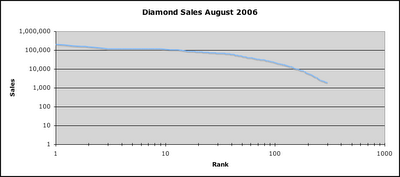
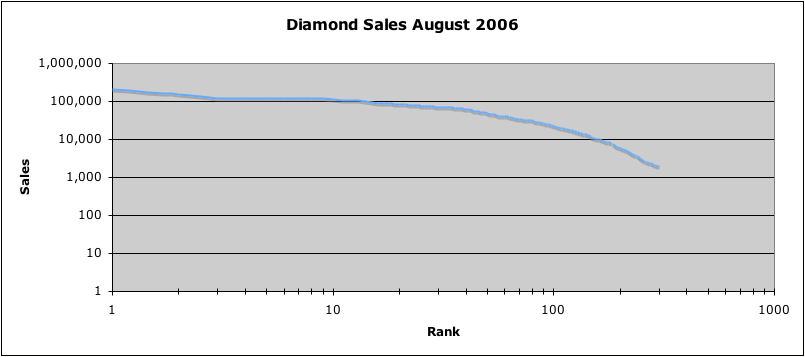
Anderson argues that--absent any market barriers--the natural shape of markets is to follow a power law. This can be visualized by graphing sales rank against number of units sold; on a log-log scale, the graph will be a straight line. Barriers and inefficiencies will cause the tail of the line to bend downward, and the area between the ideal straight line and the downward curve represent lost sales. Typically said graph will resemble a straight line at the top, but at some point it will deviate from the line; this represents an inflection point, and is a point where an analyst can look to see what the problem is and identify solutions.
For example, here's Anderson's graph (taken from here) of US Box Office Gross vs. Film Rank for 2003-2005:
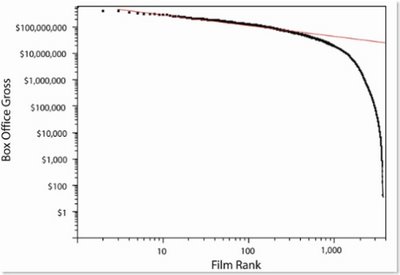
You can see the inflection point at around 350; it turns out that the carrying capacity of US megaplex theaters is a little more than 100/year, and thus over three years they show approx. 350 movies (out of the approx. 13,000 movies that were show in film festivals over the same period).
Anderson surely explains this better in his book, but I think you get the jist here.
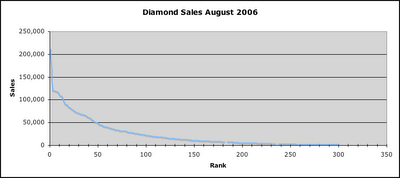
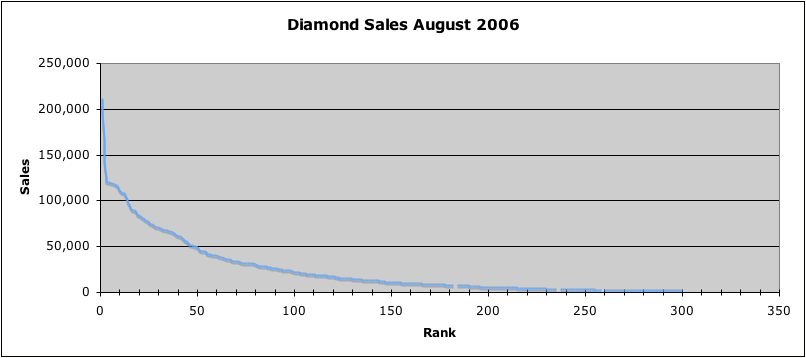
So I decided to do a little graphic of my own. I took the Diamond sales figures for August 2006 and graphed them out (click on the graphs to view them at a readable size):
Here's the raw graph:
Here it is as a log-log graph:
And here it is with an idealized market line imposed:
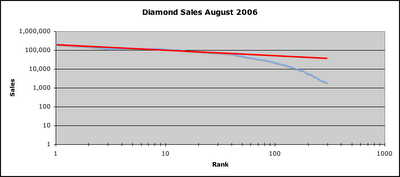
It's not surprising to see that the graph looks like many other markets. What is surprising to me is how soon the inflection point hits: right around rank #45. Looking at the raw data, it appears to be right between #45 (Sensational Spider-Man 29: 55,300) and #46 (Green Lantern Corps 3: 51,400). Put another way, that's right at about the mid-list for Marvel, just after the top books for DC, and above any other publisher.
Putting some names to the numbers: Comics like Y, the Last Man (91: 25,800), Fables (92: 25,300) & Runaways (93: 25,000) could probably be selling another 15-20,000 copies every month. Way down at the end of the tail, books like Gold Digger, Rocketo, & Action Philosophers which are selling 2,100 copies could be selling around the 20,000 range.
This represents quite an unserved market for Diamond. Of course the next question is where is that unserved market going? I suspect there are several places:
* Other distributors (for non-exclusives)
* Newsstand sales (things like Cartoon Block Party & Archie Dougle Digest)
* Trade collections (readers who don't get a comic monthly through Diamond wait for the trade, either at their local store or at a book store or through Amazon)
* Unserved at all (people who would enjoy the comics but don't know about or can't find them)
All of these of course are the concern of Diamond. The last should be a concern to all publishers.
The follow-up question after this is why is the inflection point occuring, and how can it be eliminated? I don't have a good answer yet, but I suspect it has something to do with either the promotional outlay, the 'rack space' for new comics in a typical store, or some combination of the two.
Any other thoughts?
In particular, I decided to take a look at actual sales numbers from Diamond to see if any Long Tail lessons can be learned.
Anderson argues that--absent any market barriers--the natural shape of markets is to follow a power law. This can be visualized by graphing sales rank against number of units sold; on a log-log scale, the graph will be a straight line. Barriers and inefficiencies will cause the tail of the line to bend downward, and the area between the ideal straight line and the downward curve represent lost sales. Typically said graph will resemble a straight line at the top, but at some point it will deviate from the line; this represents an inflection point, and is a point where an analyst can look to see what the problem is and identify solutions.
For example, here's Anderson's graph (taken from here) of US Box Office Gross vs. Film Rank for 2003-2005:
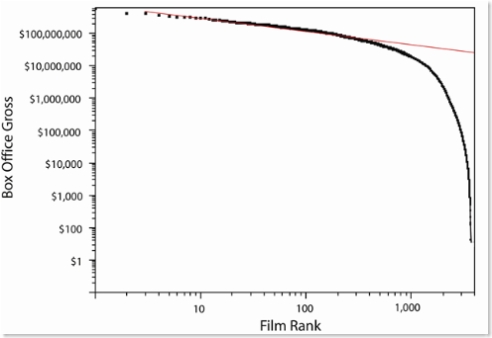
You can see the inflection point at around 350; it turns out that the carrying capacity of US megaplex theaters is a little more than 100/year, and thus over three years they show approx. 350 movies (out of the approx. 13,000 movies that were show in film festivals over the same period).
Anderson surely explains this better in his book, but I think you get the jist here.
So I decided to do a little graphic of my own. I took the Diamond sales figures for August 2006 and graphed them out (click on the graphs to view them at a readable size):
Here's the raw graph:
Here it is as a log-log graph:
And here it is with an idealized market line imposed:
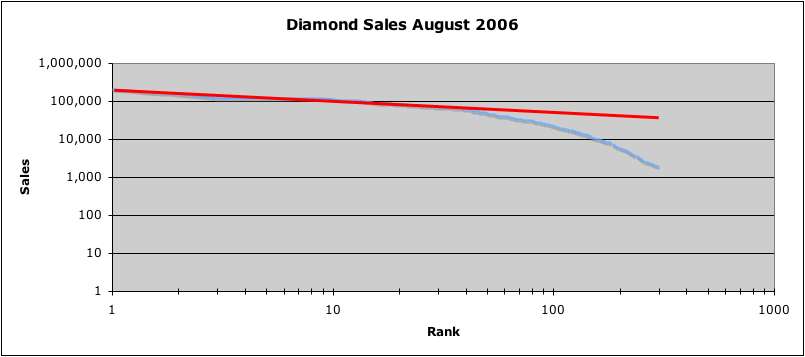
It's not surprising to see that the graph looks like many other markets. What is surprising to me is how soon the inflection point hits: right around rank #45. Looking at the raw data, it appears to be right between #45 (Sensational Spider-Man 29: 55,300) and #46 (Green Lantern Corps 3: 51,400). Put another way, that's right at about the mid-list for Marvel, just after the top books for DC, and above any other publisher.
Putting some names to the numbers: Comics like Y, the Last Man (91: 25,800), Fables (92: 25,300) & Runaways (93: 25,000) could probably be selling another 15-20,000 copies every month. Way down at the end of the tail, books like Gold Digger, Rocketo, & Action Philosophers which are selling 2,100 copies could be selling around the 20,000 range.
This represents quite an unserved market for Diamond. Of course the next question is where is that unserved market going? I suspect there are several places:
* Other distributors (for non-exclusives)
* Newsstand sales (things like Cartoon Block Party & Archie Dougle Digest)
* Trade collections (readers who don't get a comic monthly through Diamond wait for the trade, either at their local store or at a book store or through Amazon)
* Unserved at all (people who would enjoy the comics but don't know about or can't find them)
All of these of course are the concern of Diamond. The last should be a concern to all publishers.
The follow-up question after this is why is the inflection point occuring, and how can it be eliminated? I don't have a good answer yet, but I suspect it has something to do with either the promotional outlay, the 'rack space' for new comics in a typical store, or some combination of the two.
Any other thoughts?
Tuesday, September 12, 2006
More TokyoPop & Viz Charts
Following up on my post from earlier today about the volume number counts for TokyoPop & Viz:
I ran the numbers from the August & July Previews as well. Here are the histograms (you may need to click to see the larger version to read them fully):
TokyoPop:
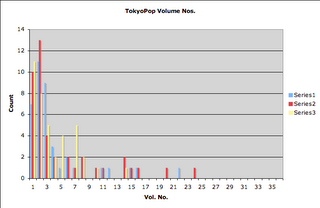
Viz:
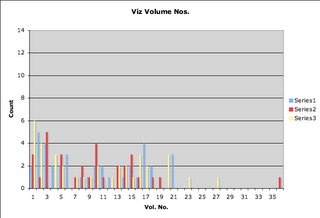
Series 1 (blue) = September
Series 2 (red) = August
Series 3 (yellow) = July
For TokyoPop:
September: Count: 39; Median: 3
August: Count: 42; Median: 2
July: Count: 39; Median: 3
For Viz:
September: Count: 38; Median: 8.5
August: Count: 31; Median: 9
July: Count: 35; Median: 9
(Note: for both publishers, I did not count books/novels, just manga volumes.)
With three months of data, it looks like the pattern is holding; TokyoPop produces more manga with low volume numbers, and more new titles each month than Viz.
I ran the numbers from the August & July Previews as well. Here are the histograms (you may need to click to see the larger version to read them fully):
TokyoPop:

Viz:

Series 1 (blue) = September
Series 2 (red) = August
Series 3 (yellow) = July
For TokyoPop:
September: Count: 39; Median: 3
August: Count: 42; Median: 2
July: Count: 39; Median: 3
For Viz:
September: Count: 38; Median: 8.5
August: Count: 31; Median: 9
July: Count: 35; Median: 9
(Note: for both publishers, I did not count books/novels, just manga volumes.)
With three months of data, it looks like the pattern is holding; TokyoPop produces more manga with low volume numbers, and more new titles each month than Viz.
TokyoPop & Viz Output
Over at Crocodile Caucus, Lyle asks:
It's a good question. In terms of sheer number of volumes, TP & Viz put out about the same number of titles per month, but they definitely have a different image in the comics blogosphere. Some of the responder comments point to things like quality, shipping schedule, and Viz's use of imprints.
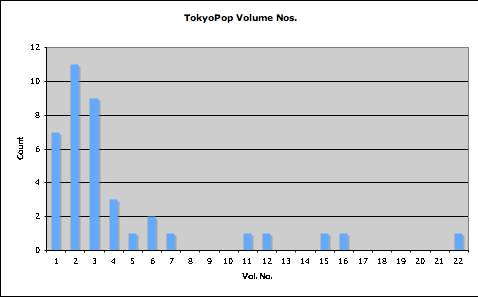
Those are some good anectdotal possibilities--and when you're dealing with perception, anectdotal evidence can go a long way. But I suspected there was something else going on as well, so I did some number crunching. I looked at the TP & Viz sections in the current issue of Previews (September, for items supposedly on sale in November). A pure count shows that TP has 39 volumes, Viz has 38 (for purposes of this analysis I didn't count Shojo Beat or Shonen Jump). But then I counted how many titles each publisher had with a particular volume number; i.e. how many titles were on vol. 1, how many on vol. 2, etc. Here are the results in handy histograms:
TokyoPop:
Viz:
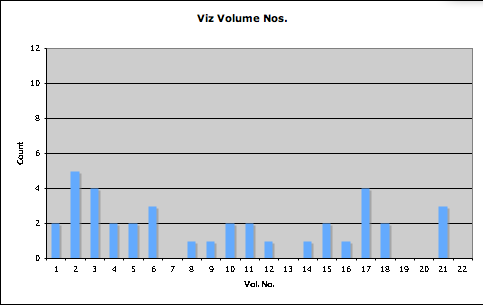
As can be plainly seen from these graphs, TP's output is weighted far more towards the early volume numbers, while Viz's output as a whole is far more mature. The median volume number for TP is 3, while the median for Viz is 8.5.*
So that's where the “throw it at the wall and see what sticks” image for TP comes from; they're putting out a lot more new series every month, while Viz is more likely to stick with longer-running series. This means that each month readers and retailers are faced with an array of many new choices (or ordering decisions) from TP, while with Viz they know more what they're getting into.
Just another piece of the puzzle.
(* You might be tempted to try to take an average, but I think that your college statistics professor would likely have told you that you cannot take averages of ordinal data.)
Update: Three months worth of data graphed here.
Why does the large number of titles that Tokyopop publishes inspire phrases like “flooding the market” and “throw it at the wall and see what sticks” when Viz, who also publishes a large number of titles never generates the same complaint?
It's a good question. In terms of sheer number of volumes, TP & Viz put out about the same number of titles per month, but they definitely have a different image in the comics blogosphere. Some of the responder comments point to things like quality, shipping schedule, and Viz's use of imprints.
Those are some good anectdotal possibilities--and when you're dealing with perception, anectdotal evidence can go a long way. But I suspected there was something else going on as well, so I did some number crunching. I looked at the TP & Viz sections in the current issue of Previews (September, for items supposedly on sale in November). A pure count shows that TP has 39 volumes, Viz has 38 (for purposes of this analysis I didn't count Shojo Beat or Shonen Jump). But then I counted how many titles each publisher had with a particular volume number; i.e. how many titles were on vol. 1, how many on vol. 2, etc. Here are the results in handy histograms:
TokyoPop:
Viz:
As can be plainly seen from these graphs, TP's output is weighted far more towards the early volume numbers, while Viz's output as a whole is far more mature. The median volume number for TP is 3, while the median for Viz is 8.5.*
So that's where the “throw it at the wall and see what sticks” image for TP comes from; they're putting out a lot more new series every month, while Viz is more likely to stick with longer-running series. This means that each month readers and retailers are faced with an array of many new choices (or ordering decisions) from TP, while with Viz they know more what they're getting into.
Just another piece of the puzzle.
(* You might be tempted to try to take an average, but I think that your college statistics professor would likely have told you that you cannot take averages of ordinal data.)
Update: Three months worth of data graphed here.
Thursday, September 15, 2005
Diamond and The Long Tail
So, the blogosphere is abuzz this week with the news that Diamond wil be enforcing a hard cutoff on low-selling comics. Essentially they won't go forward with orders for anything that doesn't generate at least $600 in orders (or approx 500 copies for a standard $3 comic). If you're one of the three people reading this who hasn't caught up on this news, you can read more about it here, here, here, and here, amongst many other places.
Most observers have been saying that, from a purely economic & business standpoint, Diamond should have done this a long time ago. But no one seems to be talking about The Long Tail effect (or if they have, I haven't come across it yet).
For those unfamiliar, a quick summary: As relating to commerce, especially arts-commerce (or really any non-fungible goods), The Long Tail was coined by Chris Anderson in 2004. Basically he pointed out that collectively, products that have low demand, as an aggregate, comprise a market comperable to the high demand products. The problem is that traditional retail outlets, with the demands of physical storage and distribution costs, realistically can only afford to carry the high demand products, meaning that the market for low demand products, while real and existing, is untapped. The real revolution in online retailing has been the ability to tap into the low demand market; as examples, look at Amazon, iTunes, and NetFlix.
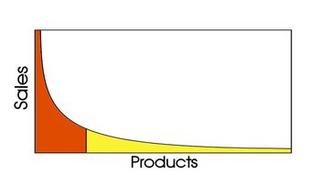
(You can read better and more in-depth explainations at Wikipedia and on Anderson's blog.)
What we see with Diamond's moves then is a perfect example of this in the comic book direct market. Even though the aggregate market for these low print run comics undoubtedly exists, the current retail and distribution chain cannot support it. (I've pointed out before that all it takes for a comic to be profitable is for each comic store to order one copy, but that for various reasons that's never going to happen.)
So, while it "makes sense" that Diamond is taking the steps that it's taken, it also stands to reason that there is a sizable untapped market for low print run comics, and that there needs to be an online retailer that traffics effectively in these comics. A store that's willing to work with the smaller distributers and with publishers directly, and produce a quality online shapping experience. About the closest we have now are Mars Import, although they deal pretty much exclusively with graphic novels; and Poopsheet Shop, which deals exclusively with minis. Both are good at what they do, and could probably expand out more generally to fill the gap, or maybe a new store is needed.
I surely haven't thought this through fully, and I don't have the disposition to be a retailer myself, but it seems to me that there's a market opportunity just waiting to be filled.
Most observers have been saying that, from a purely economic & business standpoint, Diamond should have done this a long time ago. But no one seems to be talking about The Long Tail effect (or if they have, I haven't come across it yet).
For those unfamiliar, a quick summary: As relating to commerce, especially arts-commerce (or really any non-fungible goods), The Long Tail was coined by Chris Anderson in 2004. Basically he pointed out that collectively, products that have low demand, as an aggregate, comprise a market comperable to the high demand products. The problem is that traditional retail outlets, with the demands of physical storage and distribution costs, realistically can only afford to carry the high demand products, meaning that the market for low demand products, while real and existing, is untapped. The real revolution in online retailing has been the ability to tap into the low demand market; as examples, look at Amazon, iTunes, and NetFlix.
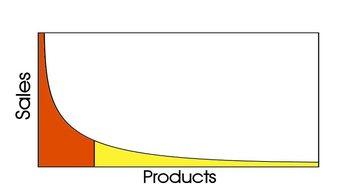
(You can read better and more in-depth explainations at Wikipedia and on Anderson's blog.)
What we see with Diamond's moves then is a perfect example of this in the comic book direct market. Even though the aggregate market for these low print run comics undoubtedly exists, the current retail and distribution chain cannot support it. (I've pointed out before that all it takes for a comic to be profitable is for each comic store to order one copy, but that for various reasons that's never going to happen.)
So, while it "makes sense" that Diamond is taking the steps that it's taken, it also stands to reason that there is a sizable untapped market for low print run comics, and that there needs to be an online retailer that traffics effectively in these comics. A store that's willing to work with the smaller distributers and with publishers directly, and produce a quality online shapping experience. About the closest we have now are Mars Import, although they deal pretty much exclusively with graphic novels; and Poopsheet Shop, which deals exclusively with minis. Both are good at what they do, and could probably expand out more generally to fill the gap, or maybe a new store is needed.
I surely haven't thought this through fully, and I don't have the disposition to be a retailer myself, but it seems to me that there's a market opportunity just waiting to be filled.
Subscribe to:
Posts (Atom)