Showing posts with label long tail. Show all posts

Friday, October 20, 2006

Diamond and the Long Tail 2

Over a year ago I wrote a blog post about Diamond and the Long Tail. This past Monday Chris Anderson was on campus and gave an interesting presentation about the Long Tail, which got me thinking about it again.

In particular, I decided to take a look at actual sales numbers from Diamond to see if any Long Tail lessons can be learned.

Anderson argues that--absent any market barriers--the natural shape of markets is to follow a power law. This can be visualized by graphing sales rank against number of units sold; on a log-log scale, the graph will be a straight line. Barriers and inefficiencies will cause the tail of the line to bend downward, and the area between the ideal straight line and the downward curve represent lost sales. Typically said graph will resemble a straight line at the top, but at some point it will deviate from the line; this represents an inflection point, and is a point where an analyst can look to see what the problem is and identify solutions.

For example, here's Anderson's graph (taken from here) of US Box Office Gross vs. Film Rank for 2003-2005:
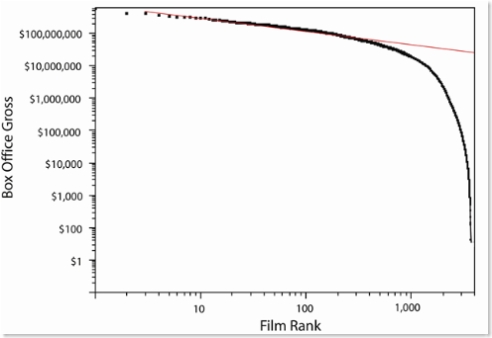
US Box Office Gross vs. Film Rank for 2003-2005

You can see the inflection point at around 350; it turns out that the carrying capacity of US megaplex theaters is a little more than 100/year, and thus over three years they show approx. 350 movies (out of the approx. 13,000 movies that were show in film festivals over the same period).

Anderson surely explains this better in his book, but I think you get the jist here.


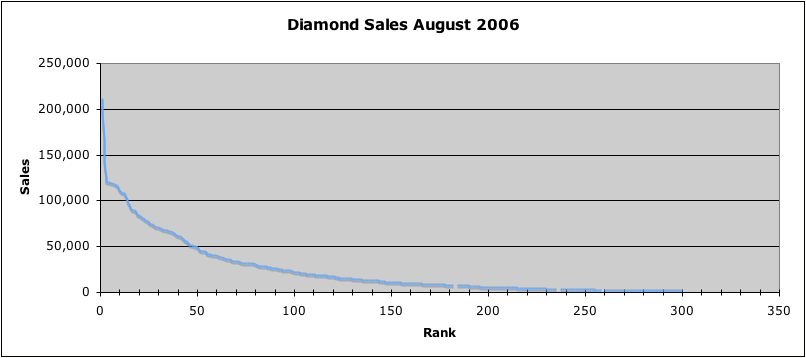
So I decided to do a little graphic of my own. I took the Diamond sales figures for August 2006 and graphed them out (click on the graphs to view them at a readable size):

Here's the raw graph:


Here it is as a log-log graph:
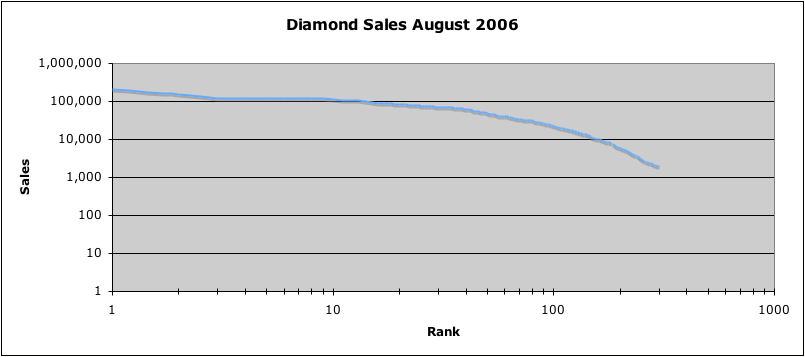


And here it is with an idealized market line imposed:
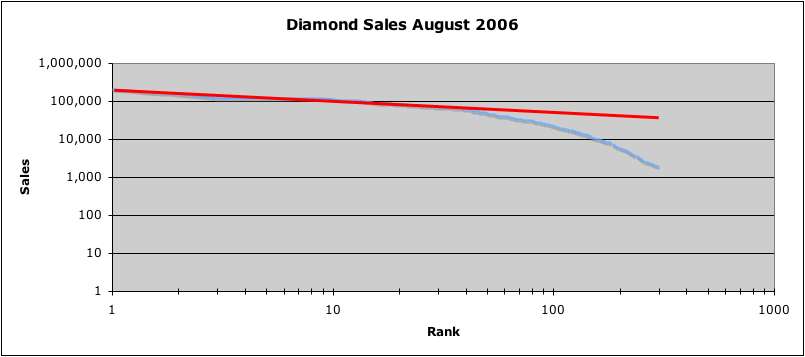


It's not surprising to see that the graph looks like many other markets. What is surprising to me is how soon the inflection point hits: right around rank #45. Looking at the raw data, it appears to be right between #45 (Sensational Spider-Man 29: 55,300) and #46 (Green Lantern Corps 3: 51,400). Put another way, that's right at about the mid-list for Marvel, just after the top books for DC, and above any other publisher.

Putting some names to the numbers: Comics like Y, the Last Man (91: 25,800), Fables (92: 25,300) & Runaways (93: 25,000) could probably be selling another 15-20,000 copies every month. Way down at the end of the tail, books like Gold Digger, Rocketo, & Action Philosophers which are selling 2,100 copies could be selling around the 20,000 range.

This represents quite an unserved market for Diamond. Of course the next question is where is that unserved market going? I suspect there are several places:

* Other distributors (for non-exclusives)

* Newsstand sales (things like Cartoon Block Party & Archie Dougle Digest)

* Trade collections (readers who don't get a comic monthly through Diamond wait for the trade, either at their local store or at a book store or through Amazon)

* Unserved at all (people who would enjoy the comics but don't know about or can't find them)

All of these of course are the concern of Diamond. The last should be a concern to all publishers.

The follow-up question after this is why is the inflection point occuring, and how can it be eliminated? I don't have a good answer yet, but I suspect it has something to do with either the promotional outlay, the 'rack space' for new comics in a typical store, or some combination of the two.

Any other thoughts?

Thursday, September 15, 2005

Diamond and The Long Tail

So, the blogosphere is abuzz this week with the news that Diamond wil be enforcing a hard cutoff on low-selling comics. Essentially they won't go forward with orders for anything that doesn't generate at least $600 in orders (or approx 500 copies for a standard $3 comic). If you're one of the three people reading this who hasn't caught up on this news, you can read more about it here, here, here, and here, amongst many other places.

Most observers have been saying that, from a purely economic & business standpoint, Diamond should have done this a long time ago. But no one seems to be talking about The Long Tail effect (or if they have, I haven't come across it yet).

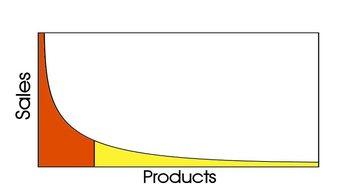
For those unfamiliar, a quick summary: As relating to commerce, especially arts-commerce (or really any non-fungible goods), The Long Tail was coined by Chris Anderson in 2004. Basically he pointed out that collectively, products that have low demand, as an aggregate, comprise a market comperable to the high demand products. The problem is that traditional retail outlets, with the demands of physical storage and distribution costs, realistically can only afford to carry the high demand products, meaning that the market for low demand products, while real and existing, is untapped. The real revolution in online retailing has been the ability to tap into the low demand market; as examples, look at Amazon, iTunes, and NetFlix.


(You can read better and more in-depth explainations at Wikipedia and on Anderson's blog.)

What we see with Diamond's moves then is a perfect example of this in the comic book direct market. Even though the aggregate market for these low print run comics undoubtedly exists, the current retail and distribution chain cannot support it. (I've pointed out before that all it takes for a comic to be profitable is for each comic store to order one copy, but that for various reasons that's never going to happen.)

So, while it "makes sense" that Diamond is taking the steps that it's taken, it also stands to reason that there is a sizable untapped market for low print run comics, and that there needs to be an online retailer that traffics effectively in these comics. A store that's willing to work with the smaller distributers and with publishers directly, and produce a quality online shapping experience. About the closest we have now are Mars Import, although they deal pretty much exclusively with graphic novels; and Poopsheet Shop, which deals exclusively with minis. Both are good at what they do, and could probably expand out more generally to fill the gap, or maybe a new store is needed.

I surely haven't thought this through fully, and I don't have the disposition to be a retailer myself, but it seems to me that there's a market opportunity just waiting to be filled.