Showing posts with label interview. Show all posts
Showing posts with label interview. Show all posts
Wednesday, June 18, 2014
I interview Jerzy Drozd about Kids Read Comics!
Over at The Beat, I interview Jerzy Drozd and get the behind-the-scenes story about the Kids Read Comics! Festival.


Monday, June 04, 2012
The Garlicks Interview: Q&A with Lea Hernandez
Writer and artist Lea Hernandez has been involved in both print and online comics for over twenty-five years. In the print world she is best known for her work on the graphic novels Cathedral Child, Clockwork Angels, Rumble Girls, and Killer Princesses (with Gail Simone). In the world of Webcomics she has published on the site Modern Tales and was the original editor of Girlamatic.
Lea's latest project is The Garlicks, an all-ages story about a vampire family that will be published online and then collected into a print edition. Lea is seeking funding for the project via Kickstarter. She took time out of her busy schedule to answer my questions over email about her new venture:

YACB: Prior to The Garlicks you've written and drawn several other comic projects. What attracts you to comics as a medium for telling stories?
LH: I like to write and draw. Telling stories any other way doesn't satisfy me.
YACB: When you write and draw a comic, what is your creative process like? Do you first produce a written script or an outline? Or do you work from rough notes and/or thumbnails?
LH: It depends. In the case of The Garlicks, it started with a letter I wrote to a friend after I mis-read the name "Gorelick" (Go-REL-ick) as GORE lick. I thought, that's a wonderfully demented name for a vampire, and immediately knew I didn't want to write horror (which Gore Lick demands), I started playing with the name. A short Google search later confirmed that somehow there had never been vampire named The Garlicks. Then I poured out what I was thinking to the friend: the names, motivations and first story were right there.
I write a full script: page layout, panel descriptions, dialogue.
I've tried other ways, but that's the only one that works for me. Since
The Garlicks is also episodic, I keep a file of story ideas to draw on.
After scripting, I do rough layouts in pencil on paper, then import
them into Photoshop, improve them (usually) and then tighten the
pencils. After that, I either print them out and use a light table to
finish the art by hand, or continue to ink and paint digitally. (The vid for my Kickstarter shows this process.)
YACB: You've mentioned that The Garlicks is your first creator-owned graphic novel that you've colored yourself (Lovern Kindzierski previously colored your work on the Hardy Boys graphic novel). Why did you decide to produce The Garlicks in color, and how did you decide on the color palette?
LH: My good friend Adam Warren (Empowered) kept telling me my color work was stronger than my b&w/limited palette/pencils, going back to my story for Comic Book Tattoo, until I took the plunge.
He was right, and I've had so much pleasure in working in color.

LH: I wanted the art to have the feeling of a sketchbook/diary, and went back to some of my previous work that I got the best response to, A comic that I do every few years, Near-Life Experience, which has diary-like art with a freer page structure. It's also the structure that makes me happiest. I suppose that comes through!
YACB: Why did you decide to make your protagonist, Pandora, an aspiring graphic novelist?
LH: I wanted to do a comic in a style that was less grid, more open, which led me to decide it should be someone's notebooks. So, Pandora got the job of being a graphic novelist. I also want to put this aspiration to write and draw stories in the minds of The Garlicks intended audience.
YACB: Why vampires? How do you feel that vampires work as a vehicle for telling stories in general and The Garlicks in particular?
LH: I was ambiguous about vampires. I've liked books that happened to have vampires in them, but I wouldn't choose a read because it had vampires. I didn't tell myself, "No vampires EVER!" I couldn't let The Garlicks idea go once it had me, saturated sub-genre or not. As for The Garlicks, it's useful for showing sibling rivalry and bigotry. And, I like to think, will be a take on vampires that's new. Or new-ish.
YACB: You've stated that you intend for The Garlicks to be targeted towards girls (though any comics reader should be able to enjoy it). What led you to decide to target that demographic with this comic?
LH: I make comics I wanted to read as a kid/teenager. Writing for girls (which is a habit, rather than a targeting move) has the happy side effect of being a small remedy to the problem that there are flat-out not enough comics for girls. I always hope for crossover appeal (and I get it), but I create for girls first.
YACB: What are the elements of The Garlicks that you feel make it 'for girls'? (In both a 'for females' and 'for younger readers' sense.)
LH: A lead who is a girl, for one. She has a relatable problem a lot of girls who are older siblings have: riding herd on the younger ones.
Pandora is cute, but not sexualized, so a girl/woman reading The Garlicks doesn't have to have that feeling of, "You said this was for me, but there's the thing that shows me you didn't have the confidence to not throw in "something for the guys."
There's something wonderful about knowing, as a girl/woman, that something is for you and will always be for you first.

LH: Brianne Drouhard, Brittney Lee, Steven Silver, Lauren Faust, Mike Rohde. The first three are concept artists and character designers with lovely senses on color, weight and line. They're fantastic. The fourth, Lauren Faust, I was a fan of back to Cats Don't Dance, a criminally underrated animated movie. Her take on My Little Pony showed that "girly" had appeal across gender and age, but could remain true to its audience. Mike Rohde invented a method of visual note taking called Sketchnotes. Being inspired by his work after a long, depressing dry spell helped give me a new direction in my comics.
YACB: How have your previous experiences with Webcomics informed how you are producing The Garlicks? Why did you decide to use Kickstarter as a method of funding this latest project?
LH: Webcomics are a proven model in that they are the most frictionless way to get a story to an audience. There's also instant gratification for reader and creator. There's no working in a vacuum, then sending it off, then waiting for it to hit shelves. That can take three or more years, whereas a webcomic can start as soon as a creator has drawn it. No submissions, no delays, no rejection, no waiting a year or two AFTER completion to see a physical book.
I decided to use Kickstarter for two reasons. One: I need a job while I look for regular employment, so I made one. Two: people have responded very well to The Garlicks, and I have had no time to add to the webcomic because I've been trying to cram it in the spaces between commissions, school, job hunting. A funded Kickstarter solves both problems very well for me and my fans.
YACB: Is there anything else that you'd like to tell readers about The Garlicks? Any other projects that you are working on? (Plug away!)
LH: That I won't get to that $40,000 Kickstarter finish line without a LOT of help in the form of backers and supporters! It's not just important to me (but getting a year to work on my next book without worrying about eating or bills is REALLY important), it's important to keep showing that 1) girls DO want comics and 2) everyone wants GOOD comics.
I'm also working on a great graphic novel by Josh Hechinger called The Moon is Mine, about a candy factory on the moon and the giant robot battle to control it. Josh is a talented writer, insanely so, so I'm giving it my best, albeit slowly!
Other than that, not much, because running a Kickstarter takes a LOT of time. I'm going to be writing an article about Kickstarting with Dani O'Brien, writer of All New Issues, about putting together and running a campaign. I'm enjoying myself, because I love challenging projects, but it's also an emotional roller coaster and a lot of stress. Fun, but very very hard.

Thanks again to Lea for taking the time to answer my questions. You can follow Lea on Twitter @theDivaLea ; see images from The Garlicks and other projects on Flickr at http://www.flickr.com/photos/divalea/ (from where images on this post are taken); or read her LiveJournal Dangerous Beauty at http://divalea.livejournal.com/ . The Kickstarter campaign for The Garlicks is at http://www.kickstarter.com/projects/divalea/the-garlicks-pandora-orange-fail-vampire
Thursday, May 17, 2012
Sullivan's Sluggers Interview: Q&A with Mark Andrew Smith
 Writer Mark Andrew Smith has been active in the comics industry for
several years now. He is the co-creator and editor of the Eisner
Award-winning Popgun Comics anthology, and the writer of several comics series (published mostly though Image Comics) including Amazing Joy Buzzards (art by Dan Hipp), The New Brighton Archeological Society (art by Matthew Weldon), and Gladstone's School for World Conquerors (art by Armand Villavert).
Writer Mark Andrew Smith has been active in the comics industry for
several years now. He is the co-creator and editor of the Eisner
Award-winning Popgun Comics anthology, and the writer of several comics series (published mostly though Image Comics) including Amazing Joy Buzzards (art by Dan Hipp), The New Brighton Archeological Society (art by Matthew Weldon), and Gladstone's School for World Conquerors (art by Armand Villavert).Mark's latest comic is Sullivan's Sluggers, a baseball/horror original graphic novel drawn by James Stokoe, the publication of which will be funded via Kickstarter. Mark took time out of his busy schedule to answer my questions over email about his new venture:
YACB: Prior to Sullivan's you've written several other comic projects. What attracts you to comics as a medium for telling stories?
MAS: I really love the blending of words and images, and the pacing of comic books. I’ve loved reading comic books ever since I was a kid, and they’re something I love to create. For me there is an energy to comic books that only comics can capture through the art and words on the page.
YACB: What kind of comics did you read as a kid? Are there any that you consider 'formative'? How do those comics that you read as a kid inform your comics work today?
MAS: As a kid I was a huge Spider-Man fan, and I also read the Mirage run of TMNT that I was a huge fan of. I think TMNT was very formative for me. After the crash in the 90s I stopped reading comics but I was still interested in making them. At University my faculty adviser told me about Understanding Comics and a light just clicked in my head. I went to the comic shop and caught up with what I’d missed over the past 10 years. It was great and like school for me to read that much material at once.
YACB: When you returned to comics after a 10 year absence, what were the comics that grabbed your attention? How did they appeal to you as an adult reader?
MAS: It was the indy comics that grabbed my attention and especially the work of Jim Mahfood, Scott Morse, Paul Pope, Mike Mignola, Frank Miller, and Mike Allred that got me interested again With some books they had such a minimal style but the stories they told packed a big punch and that was really interesting to me. I kind of discovered that there was the possibility of telling a moving and impactful story like Hamlet but with stick figure art, and if you expressed it enough through the art it would still resonate with the reader. I came in finding indy comics and new characters that were interesting. I think Madman is my favorite character ever.
YACB: While there's a long history of the horror genre in comics, the list of baseball comics is much shorter. What led you to combine the two in Sullivan's Sluggers?
MAS: I’ve always been a fan of baseball, and baseball movies growing up. I’ve also been a fan of fun splatter horror films too. I think the two make for a great combination in seeing a team of baseball players go through horrible conditions and using their skills as athletes to survive.
YACB: You mentioned baseball films and splatter horror films as inspirations for Sullivan's. Do you consider your comics work to be cinematic? How do you feel that movies inform your comics work in general and Sullivan's Sluggers in particular?
MAS: I think my comic work is cinematic at times for pacing, and letting the images tell the story. The downside of this is that it gets massive in length and projects grow and grow. I think with most of my work this was the case and with Sullivan’s. With something like Gladstone’s School for World Conquerors it’s cinematic in that it’s epic with huge world building and action. I went to film school at UC Santa Barbara and films and film theory definitely help to craft my work.

YACB: What is it about baseball that you feel makes it a good setting for stories in general and for Sullivan's in particular?
MAS: What I love about baseball is that it's a great team dynamic with so many different personalities on a team that all want different things. Actually, keeping track of an entire baseball team in the comic was a challenge to do, and I had to check the character roster a lot. With baseball there is an epic history to baseball spanning well over a hundred years and also potential for ghosts and monsters.
YACB: What attracted you to James Stokoe as an artistic collaborator? What strengths does he bring to Sullivan's Sluggers?
MAS: I think I was the first person to know about James Stokoe, and we published Orc Stain before anyone else in the Popgun Anthologies. James Stokoe is in my opinion the Jimmy Hendrix of comics, and his art is fantastic. He’s able to convey great settings, great action, and great character personality in his work, in telling the story with me through his art.
YACB: What is your collaboration process like with James? Do you give him a full script or a plot to work from? At what point in the development process of Sullivan's did he come on board?
MAS: I give James a full script but it’s more by action beat by panel and it’s definitely not an Alan Moore style script describing everything in detail. It does what I want and gets the results that I want from James. I had the first 32 pages written and the characters all picked out. He just started drawing them and I don’t think he even did concepts for them but I gave a lot of references and descriptions about the characters.
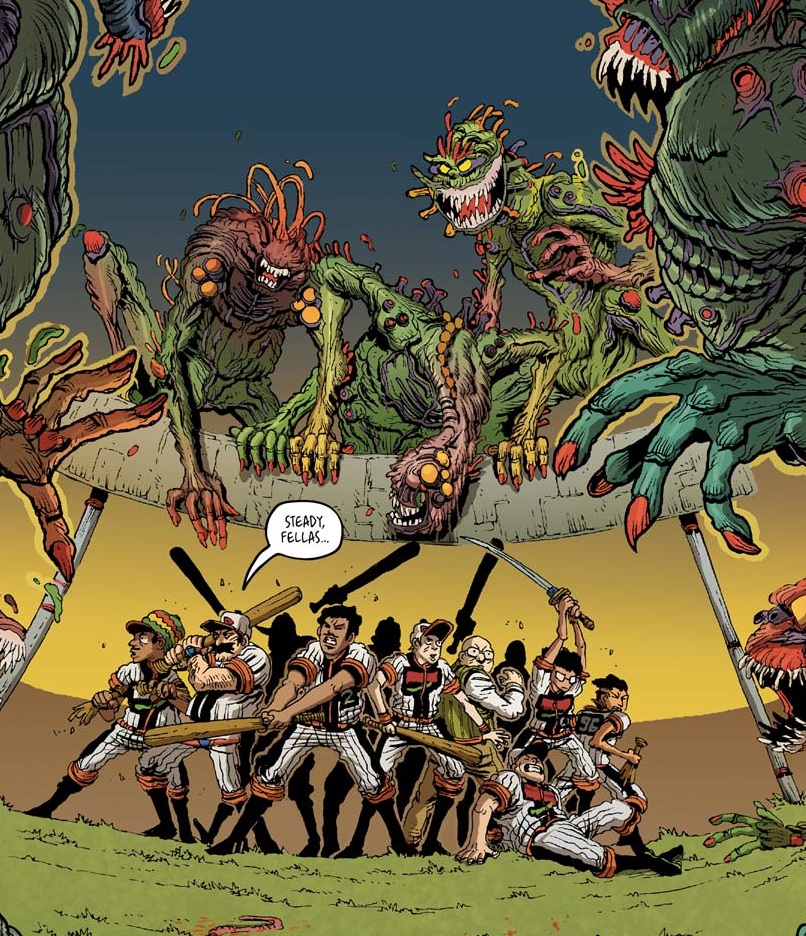
MAS: Rodrigo Aviles is our colorist and I knew a more colorful book would make the project look better and so I picked him. I think James comes from the same coloring school as well and if you see his other work, the coloring is like bubble gum.
YACB: Why did you decide to use Kickstarter as a means of funding the hardcover edition of Sullivan's Sluggers?
MAS: For Sullivan’s Sluggers, I wanted a book just for me that I’d be proud of having on my bookshelf. I wanted to do a beautiful edition of the book that made it collectable. I also wanted to test Kickstarter out with Sullivan’s and see if doing something exclusive on Kickstarter would better connect me with my audience and rally their support. It’s risky but also will be very rewarding and I’m glad I’m taking the Kickstarter risk.
YACB: Will Sullivan's Sluggers be available outside of the Kickstarter campaign? In what format(s)?
MAS: I’m still debating it right now but I don’t have the answer. I think it would do well in single issues at comic shops, so we’ll see if that’s an option in the future. With Sullivan’s I’ll probably pace it out over a longer duration of time for the releases if there are different formats because it is important to sell the hardcover and recouping and making money on Sullivan's is important to me so that I can get material out faster in the future.
YACB: What other projects do you currently have in the pipeline? (Plug away!)
MAS: Right now I'm working on series 2 of Gladstone's School for World Conquerors and also the New Brighton Archeological Society and they should be out this year. We're coloring away at the moment on those.
YACB: Is there anything else that you'd like people to know about Sullivan's Sluggers?
MAS: Sullivan's Sluggers is awesome and be sure buy one (or three)!
My thanks again to Mark for taking the time to answer my questions. You can follow Mark on Twitter at @MarkAndrewSmith . The Kickstarter campaign for Sullivan's Sluggers is at http://www.kickstarter.com/
Thursday, September 15, 2011
Q&A with Jennifer & David Skelly

Am I correct that this is your first published comic book work?
DS: Our first published comic was a book called Zevo-3. It was a tie-in to an animated teen superhero TV series that we worked on for Nicktoons. After we had written several episodes of the show, the producer came to us and said, "Do you guys know anything about comic books? We're thinking about promoting the show with one."
JS: Considering our closets are filled with comic boxes, not clothes, we said, "yes..."
DS: The show, Zevo-3, was produced by Skechers Entertainment. They created original characters and backstories to go along with their different lines of kids' shoes.
JS: So we wrote a comic book that went into bazillions of Skechers shoe boxes!
DS: That book was so well-received that they asked us to write comics for all the rest of their properties. (I drew the breakdowns for those as well.)
What interested you in writing for comics?
DS: They say you are what you eat, and I ate a lot of comics as a kid.
JS: *snort*
DS: I love comics. I've read them all my life. It was a huge part of my childhood. They were my escape, my refuge from the real world. I started with Golden Key and Disney comics. I loved them, and in particular, the Uncle Scrooge comics that were written and drawn by Carl Barks. Even as a four- and five-year old I could recognize the quality of his work and distinguish it from other artists'. And then some years later, I discovered people like Chris Claremont, Walt and Louise Simonson, Wendy and Richard Pini, and Bill Sienkiewicz. Their work had such a huge impact on me — and helped shape me as a storyteller.
JS: My mom collected comic books, and as a little kid I had Archie and Donald Duck... but it was in college, when I met David, that my real love affair with comics began.
DS: And our love affair...
JS: Be quiet. I'm talking now. Where was I? Oh, yeah. Growing up, I knew and loved the DC characters. I was obsessed with comic book heroes on TV and in the movies — Richard Donner's Superman, Superfriends, Wonder Woman, Kenneth Johnson's The Incredible Hulk. But I didn't read comic books! And when David introduced me to the X-Men... wow. The characters were so flawed, so real, so human (even though they are super-human). I was hooked.
DS: In high school and college I wrote and drew a comic strip that was published in various papers, including University of Michigan's campus newspaper, The Michigan Daily. It was called Backyard Infinity. That was a great training ground for me. I learned a lot about storytelling in a visual medium, and in particular I learned a lot about brevity — making a point or making a joke with some very simple drawings and a few words. In fact, for a while, I challenged myself to write my strips with five words or less.
JS: And yet we tend to go on when being interviewed...
DS: In any case, drawing those comic strips was a direct link to the work I would later do with the Jim Henson Company and Pixar Animation Studios.
JS: As for writing comic books — we love the immediacy. In TV animation, it can be months —
DS: — or in the case of films, years —
JS: — before you see your work on the screen. In comics, there's such a fast turn-around from idea to finished product.
DS: Working on a film is like telling a joke and waiting three years to see if anybody laughs.
JS: Hahaha! That's funny!
DS: That's why I love you. You laugh at my jokes right away.
How did you get the Batman gig? Did you approach DC, or did they approach you? (Or perhaps your agent sacrificed a mint-condition copy of Giant-Size X-Men #1...)
JS: No, we approached DC.
DS: We’ve always found our own writing assignments — we’re blessed with an amazing network of friends and colleagues.
JS: One of those friends, a veteran in the comic book industry, was kind enough to introduce us to some editors at DC.
DS: We corresponded with those editors for quite a long time — months — waiting for the right opportunity to come along...
JS: I think we wore them down!
DS: Editor Rachel Gluckstern read our work and contacted us. She asked us if we’d like to pitch her a few Batman short stories.
JS: And we said, “Absolutely!”
DS: We wrote a few treatments — about a half a page each — and sent them to Rachel. She picked her favorite and we were off to the races!
How does writing a comic script compare to writing a film script?
JS: In terms of storytelling — there's absolutely no difference for us. We break the story for a 10-page comic exactly the same way we do for a 90-page feature film.
DS: Every story is about transformation. How does a character change? That's what's most interesting for us as storytellers.
JS: Though there are a few differences in the way we actually write the script.
DS: A comic book script is like personal letter to the artists. Even with artists that we never meet, we feel there's a kind of intimate collaboration. There are so many people involved in the production of a television show or film, but in its purest form, a comic book is made by a very small group of people.
Tell me more about breaking your Batman/Catwoman story. Where did the idea come from? Why did you decide to do it as a 'silent' story?
DS: Larry Hama's wordless story, "Silent Interlude," for G.I. Joe #21 really made an impression on me as a kid. I've always remembered that, and thought it would be a fun challenge to write a script with no words — and no sound effects.
JS: Film and TV are a visual medium, and for us, the acid test to know whether or not a story works is by turning the sound off. Do the images alone convey the story?
DS: Alfred Hitchcock said dialogue should be one of the many background noises in a film. We adhere to that when we're writing a script for film or television, and we feel the same about writing a script for comics. How can we keep the exposition to a minimum, and still tell a compelling, emotional story? That's the challenge.
JS: Partners and lovers have a short-hand that they use to communicate: half-sentences, looks, gestures —
DS: — and Batman and Catwoman have such a long history — they don't necessarily need to speak with one another to convey a variety of feelings. This felt like the perfect opportunity to tell a story with no words.
Did you know ahead of time who your artists were going to be? Did you have any direct communication with the artists, or was it all through the script and the editor?
DS: For this story, we didn't know who the artists would be. And because of that, we knew the script had to convey as much as possible. But we're always careful to leave room for the artists' interpretations. This is a collaborative medium, and everyone involved in the process brings their own point of view and artistry. The result is inevitably even better than what we'd imagined!
JS: This is the editor's show. For the Batman 80-Page Giant, Rachel Gluckstern was responsible for hiring us, and finding just the right artists for our story.
DS: The editor is like the producer of a film. They're responsible for deciding which stories will be made, putting the team together, and making sure it gets done on schedule and on budget.
I've often said that everyone has at least one Batman story in them; was this your definitive Batman story, or would you want to work again with the character?
DS: We have countless Batman stories we'd like to tell! We hope this is the first of many.
The two of you together teach a workshop on improv for writers; how did your improv talents come into play in writing this story? (I have visions of the two of you acting out the plot in your living room, with your son looking on with bewilderment...!)
JS: Well... we didn’t act out THIS script in front of him...
DS: Yeah, it’s kind of all sex and violence. He's only two.
JS: Improv, for us, is a way of life. Which was made especially clear to us after we had a kid.
DS: Being willing to play, being flexible, being open to new ideas — that’s what improv is all about.
JS: And that informs everything we do — including our writing. We let the characters talk to us. We write from their point of view. And we let them lead us down unexpected paths.
DS: There’s an improv game called “New Choice.” It’s one of our favorites. Whether we’re on stage performing, or at our laptops writing — we make an “offer” (a character does or says something in the context of the scene) and someone else yells, “new choice!” at which point we have to immediately — without thinking — rewind to the last action or line and redo it.
JS: And then we have to justify that new information. It’s the ultimate test of flexibility.
DS: So we play a lot of New Choice when we’re writing. We push each other to come up with something else, something better, something unexpected (but still truthful).
JS: We’re constantly asking ourselves, can that line of dialogue be funnier? More dramatic? Can this scene be more emotional? And the answer is almost always “yes.”
Why Batman? What interests you in Batman as a character?
JS: Oh! Me first! I've loved the Batman family of characters since I was a kid. I was Batgirl for Halloween in Kindergarten, 1st grade, and 2nd grade.
DS: Did you wear the same costume every year?
JS: Yes. I grew slowly. Anyway... I watched the 60's TV show religiously (and screamed in joy when Batgirl's motorcycle drove into the opening credits). And then, years later, Tim Burton's Batman rocked my world.
DS: For me, Batman is cathartic. He's the antithesis to the work I've done with Sesame Street or the Toy Story characters. Bruce Wayne is so screwed up. So tormented. So dark. And I can relate with that on a deep level.
JS: (He says while wearing a Muppet T-shirt.)
DS: I'm not saying I don't love that stuff, too! But reading — and now writing — Batman stories is a great way for me to exorcise those dark demons inside.
JS: Is that "exorcise" or "exercise?"
DS: C'mon. I'm being serious.
JS: Me too. I'm serious. See? I have Batman and Catwoman Lego figures on my desk.
DS: That is a weird non-sequitur. You and your Lego.
What would you say is your all-time favorite Batman story, and why?
JS: I'd have to go back to the movies... Batman Forever, but not the Penguin stuff — he was gross (no offense, Danny DeVito, you were supposed to be gross) — but ANY of the Catwoman/Batman stuff. The scene where they've just kicked the bleep out of each other, then have a date and start getting all touchy-feely but each is trying to keep the other from discovering their new scars. And then the scene when they're dancing and realize who each other are, and Michelle Pfeiffer says, "Does this mean we have to start fighting?" and Michael Keaton just pulls her close... makes me cry every time.
DS: My go-to is still Frank Miller's The Dark Night Returns. It's just great storytelling. Makes me cry every time.
What are some comics that you particularly enjoy? Who are the comic creators that you admire?
DS: We've both really been enjoying Brian Michael Bendis' work. His scripts for The Avengers, Ultimate Spider-Man, and Scarlet, have been particularly compelling for us.
JS: Geoff Johns' Flash and Green Lantern. Joss Whedon.
DS: Mark Millar, Frank Miller, J. Michael Straczynski. And as far as artists go, Alex Maleev, John Romita, Jr., Jim Lee, Mike Mignola...
JS: ...Frank Cho, Gurihiru's work on the Power Pack cross-over series.
DS: There are so many! And of course, the people we mentioned before — The Simonsons, Bill Sienkiewicz — were and continue to be so influential on us and on our work. We were so thrilled that Bill wanted to do the finishes on our Batman story for the 80-Page Giant!
JS: We're huge Bill Sienkiewicz fans, both professionally and personally.
DS: We're often fans of the people we're collaborating with. It's out of respect for what they've done, and who they are as human beings. And even though we may also be fans of the source material that we're helping to shepherd, we're aware that as fans, we run the risk of being too precious with the work.
JS: And the last thing we want to do is be too careful or cautious to take risks —
DS: It's our responsibility as storytellers to stay true to the tone and spirit of the source material, but also to push the boundaries.
JS: To take risks!
DS: To explore new aspects or dimensions of these characters we love. To tell stories that are relevant to today's audience, not just to rehash old material or preserve something from the past. We're not archivists, we're architects —
JS: — building on a foundation that someone else has laid.
DS: Hey, that sounds pretty good!
JS: We're passionate about what we do. We're passionate about telling great stories.
DS: And we're honored to be contributing to DC's long legacy of great storytelling.
Are there other comics characters that you would be interested writing?
JS: How much time do you have?
DS: Should I list them in alphabetical order? Seriously, there are so many. Top of my list would be more Batman... and then Spider-Man, Daredevil, Dr. Strange, Superman...
JS: I see a pattern here. For me, Wonder Woman, Kitty Pryde, Dazzler, Barbara Gordon, Rachel Summers...
DS: I'd love to write a Barbara Gordon story! Let's do that! And we've always wanted to write a Cloak and Dagger story.
JS: And the New Mutants.
DS: Love Illyana Rasputin.
JS: And the Lone Ranger.
DS: Really? I didn't know that.
JS: There should always be mystery in a relationship.
Both comics and film are visual storytelling mediums. What do you see are some of the strengths and weaknesses of comics as compared to film for telling stories?
JS: They're so different. Do you like ice cream or pudding?
DS: Huh? Um. Ice cream?
JS: The experience of seeing a movie is so different than reading a comic book. As those experiences are different from playing a video game or seeing a play. But it's all storytelling. How we choose to enjoy those stories is a matter of preference that can change from person to person or day to day.
DS: That's true. Some days I prefer pudding.
What is up next for the Skellys? Any more comics gigs on the horizon? (Plug away!)
DS: We’ve got several feature films projects that we’re developing. We’ve just started pitching them to the major studios and producers in Hollywood.
JS: We’re collaborating with some of the most talented filmmakers and conceptual artists in the industry.
DS: And we’ve got a few television projects in the works as well. We've also been doing a lot script doctoring...
JS: We’re teaching an ongoing Improv for Writers workshop in Los Angeles. (improvforwriters.com)
DS: And we’re continuing to write comic books! Wow! I guess we’re kind of busy... We should probably get back to work!
A big thanks to Jennifer and David for taking the time to talk with me. You can follow Jennifer on Twitter @jenniferskelly and on the Web at http://jenniferskelly.com ; and follow David on Twitter @davidlskelly and on the Web at http://davidskelly.com. And hopefully find their next comic book on the shelves of your local comic shop soon!
Monday, May 11, 2009
Interview with Jim Ottaviani
 Jim Ottaviani is the writer of highly-regarded comics that feature the true stories of science and scientists, comics such as Two-Fisted Science; Dignifying Science; Fallout; Suspended in Language; and Bone Sharps, Cowboys, and Thunder Lizards. Last week I interviewed Jim (via email) on the occasion of his new graphic 'novel' T-Minus: The Race to the Moon, due out next week from Simon & Schuster's Alladin imprint. Along with artists Zander Cannon & Kevin Cannon (with whom Jim last worked with on Bone Sharps), in T-Minus Jim tells the story-behind-the-story of the famed space race.
YACB: Your new book, T-Minus, is about the race to the Moon. What made you decide to cover this topic?
JimO: There are a bunch of reasons, but here's the one that comes to mind today, in part because I know you're an engineer: I find the space race inspiring because of the tremendous achievements made by U.S. and Soviet engineers in the 1960s, and the way it captured the whole world's imagination. It's rare that something that is essentially a technology-driven endeavor results in such great drama and interest -- I mean, I rely on and enjoy owning a personal computer as much as the next guy, but can't see "Macintosh: The Graphic Novel" as something I'd want to write or someone would want to read.
Now that I've said that, someone will probably do it and prove me wrong, and that would be great.
But back to your question, it was fantastic theater, and the whole world watched it.
YACB: How do you think doing this story as a comic makes it different from the many books/movies/etc. that have covered this topic in the past?
JimO: Besides being comics? That makes it different right off the bat, never mind that Zander Cannon and Kevin Cannon are great visual storytellers, so you get really good comics as well. Because it's comics, I think we were able to pack a great deal of story into relatively few pages, so that's another departure. Finally, most of the books you'll read focus only on the astronauts and cosmonauts. Those people were courageous, smart, and interesting, but the scientists and engineers they put their trust in rarely appear in the popular histories. So that's the last one.
YACB: I know that you do copious research for your books. What did you discover about the space race that was surprising?
JimO: One thing I half-knew, and the other thing I didn't know at all. The part that I had an inkling of was the amount of effort that went into this adventure. I knew a lot of people worked hard, but the amount of unpaid overtime put in by hundreds of thousands of people in the U.S. amazed me. You sometimes hear criticism of the space program as a bad way to spend taxpayer dollars. I believe there is and was waste in NASA, and I believe many things could have been done better. But I think we got a lot of bang -- rocket-fueled pun intended -- for our buck.
The other thing that struck me was the environmental message that the astronauts brought back from their journeys. These men, hard-core pragmatists all, type-A test pilots down to the last of 'em, unsentimental almost to a fault...when they saw the whole earth from space they all commented on how fragile and precious it was, and how it put the problems of taking care of the world into appropriate perspective. Read the address to Congress that Aldrin, Armstrong, and Collins made:
http://usinfo.org/PUBS/LivingDoc_e/moonlanding.htm
It reads almost as if it was a manifesto of the nascent environmental movement. While that's overstating it some, their statements are not what you'd expect from ex-military guys who most would consider representatives of the establishment. I find that remarkable, and uplifting.
YACB: Previously most of your comics work has been self-published, but T-Minus is coming from a 'regular' book publisher (Aladdin). Why the change? Who approached whom?
JimO: No particular reason for the change, other than to try something new. I can't remember the exact sequence of events, but I'm pretty sure they approached my agent. He was putting together a number of non-fiction book proposals, and asked me what I'd do if given the chance. "T-Minus!" I said. Or something to that effect. As you might guess, the original proposal is a distant cousin to the finished book, but the basic idea of telling the story of the space race from an engineering/science perspective, with the Soviet program prominently featured, was there from the start.
As for why... at the risk of sounding nonchalant and careless with my so-called career, it's at least partly true to say that I figured, why not? If they didn't like the proposal, it would get me started thinking about this story, which is one I knew I wanted to do someday, either on my own or with a larger company.
YACB: Your artists on T-Minus, Zander Cannon & Kevin Cannon, previously worked with you on Bone Sharps. How did this pairing come about again? Did working with artists you've worked with before make things easier/better? What strengths do you feel that Zander & Kevin bring to illustrating your scripts?
JimO: The pairing came about because here again, my agent asked me who I'd want to work with, and who could we suggest that would convince them to say yes. I figured it would be easy for them to say yes if we could show Aladdin that if they just let us do our thing, the worst case scenario is that they'd get something as nice as Bone Sharps. Which, as worst-case scenarios go, is pretty sweet.
So Zander and Kevin were my first choice for it, and they were interested, and boom -- just like that we were off and running. And running in step, so to speak, since working with them was easy. It was easy on Bone Sharps, and we'd never done a project together before, and now they knew what to expect from me, and I from them. I don't know how to describe it other than in terms of picking up a relationship right where we left off.
As for strengths, I don't know where to start. They can draw anything. They always serve the story, and never show off their artistic chops just for the sake of showing off their artistic chops... of which they have many. When they make changes to what I specify in the script, they have reasons. They're not always ones I agree with, but they're always worth thinking about and discussing and often worth changing the script and the upstream or downstream storytelling to accommodate their ideas. They fill in the visual gaps in my research. They can draw convincing people and machines and dinosaurs and scenes on earth and in space and in the past.
Is that enough? I'm not done, but I think you get the idea... they're professionals in all the best senses of the word, and yet they're also friends. As collaborators they're as easy and as enjoyable to work with as can be.
YACB: Having now examined in-depth the engineering side of the space program, do you agree with the assertion that what we learned from the process of going to the Moon was worth the cost?
JimO: I don't know if it was worth the engineering cost -- those sorts of things are too hard to quantify. Sorry to punt on that one, but I just can't draw a firm conclusion.
My gut says yes, though, and here's why. I just attended a talk by former astronaut and now Engineering Dean here at U-M Tony England, and in it he pointed out shortcomings of the International Space Station in terms of its scientific significance. One of the things he said struck me as an interesting contradiction, though. In the process of trying to design advanced manufacturing processes that they hope will take advantage of microgravity to produce better chips and such, engineers often come up with ways to make the improvements they wanted in the chips right here on earth. Sort of as a by-product of trying to figure out how to make things happen in space. So sure, that makes the space part beside the point, but there's still obvious value there, right? We got we wanted by virtue of being forced to think differently. And that's what we get when we put ourselves in these situations.
And as far as cost is concerned I will say this: Having looked at the numbers and made comparisons with things like the cost of the Vietnam war and what people spent on alcohol and tobacco during the Apollo era, the space program was a bargain. And as Andrew Smith pointed out in his wonderful book Moondust, if nothing else we got great theater out of it. And the cost of the space race in human lives was very low. Not zero, and we have to remember that always, but compared to war and booze and smokes? The human and dollar cost was very, very low.
And... we got more than great theater. Perhaps the most important is thing we learned is that if we really dedicate ourselves to a goal as a nation, as a species, we can do things in a few years that were unimaginable and inspiring.
YACB: What is your opinion of the current state of the US space program? Do you think that returning to the Moon is a good idea? How about going to Mars? Or should we keep doing near-Earth manned missions and unmanned probes and explorers?
JimO: My opinions are not as informed as I wish they were, but I will press on and not let ignorance get in the way of spouting off!
Current state: The Hubble telescope is magnificent, as are the Mars rovers. The shuttle is going away, about which some will say good riddance. The International Space Station is up there. It's international. It's a space station. It could be better, and better serve science, but...international! space station! I think those are good things for the human spirit. I just read about a possible change to the moon-base plans, so there's not much to say there other than Moon base! I like the idea, but maybe it's not a good one for all its appeal.
Return to the Moon: I've heard a number of convincing arguments, some directly from astronauts, that this isn't the best use of our resources. So I'm neutral to negative on it. But... Moon base! It's hard to let go of that idea.
Go to Mars: It will be very hard, and hard on the people that go. But I think we will try, and I think we should.
near-Earth and/or robotic probes: Gotta keep doing both, I think. Combining those with all of the above is a problem in terms of money, but you didn't ask me how to pay for any of this -- for which I thank you -- so I choose not to make any hard decisions today.
YACB: Knowing what you know, would you want to go into space yourself?
JimO: Yes. Full stop, sign me up, I'm ready to go right now.
YACB: Your publisher, Aladdin Paperbacks is Simon & Schuster's imprint for late elementary and early middle school kids. While all of your previous books have certainly been enjoyed by all ages, were there any challenges in making T-Minus as a book that is specifically targeted towards kids?
JimO: This is the second book I've written specifically with a young adult audience in mind, but the first won't come out for a while longer, so this is the first that readers will see.
Chronology aside, yes, there are challenges, but I was lucky to have my editor at Aladdin, Liesa Abrams, help me both understand them and figure out how to deal with them. They didn't involve dumbing the book down -- I think there's plenty of heft to the story and that adults will enjoy it too. I've been putting it this way when people ask: The young readers will have to bring their A game to the book.
But besides detail stuff like not depicting smoking and keeping a tight rein on the language to make sure it was age appropriate, one of the many things Liesa helped me do was find the right balance between gosh-wow technical material and the human element. It was hard, since we were dealing with iconic figures and far more story than you can fit between the covers of a single book, but our focus on the engineers and behind the scenes helped with the human element.
YACB: What's next for Jim Ottaviani and/or GT Labs?
JimO: Two books from First Second, and I'm working on two other books right now, about which I don't have a lot to say. Or rather I do, but I want to say it to myself first and be sure I mean it before talking about anything as basic as the general outline. But, to prove I'm crazy, one may not be comics and may not be non-fiction. The other is about Alan Turing. I'm excited about both stories! And after that, I think I found an angle on a third book in my science of the unscientific series. And after that... something else, I'm sure. I have a lot of story ideas waiting in the wings!
That concludes our interview. A big thanks to Jim for taking the time to answer my questions. You can read more about T-Minus, including an excerpt, at Jim's GT Labs Website.
Thursday, October 02, 2008
Pay no attention to the fidgety guy in the green shirt
Apparently the Ann Arbor Book Festival has posted video of the first ten minutes of the interview I did with Paul Hornschemeier back in May. (Thanks to Dirk for pointing this out.)
For the rest of the interview (over an hour long!) I posted the audio of the entire thing w while back: Paul Hornschemeier Interview - Audio
For the rest of the interview (over an hour long!) I posted the audio of the entire thing w while back: Paul Hornschemeier Interview - Audio
Monday, May 19, 2008
Paul Hornschemeier Interview - Audio
Here's the raw audio of the on-stage interview I did with creator Paul Hornschemeier (Mother, Come Home; Let Us Be Perfectly Clear; etc.) at Saturday's Ann Arbor Book Festival:
(If the embed doesn't work, here's the direct link: download. It's about 64 MB.)
I unfortunately had the levels set too low, so you may have to turn your sound volume up pretty high to hear it.
It's over an hour long. I've done a few interviews in the past, but this was the first time I ever interviewed someone live and at length. As such, the topics of conversation kind of bounce around, but I still think it went well.
A big thanks to Paul, who was a great interview subject, interesting and entertaining, able to take my questions and run with them. If you're ever looking for someone to invite as a speaker, I can recommend him heartily.
(If the embed doesn't work, here's the direct link: download. It's about 64 MB.)
I unfortunately had the levels set too low, so you may have to turn your sound volume up pretty high to hear it.
It's over an hour long. I've done a few interviews in the past, but this was the first time I ever interviewed someone live and at length. As such, the topics of conversation kind of bounce around, but I still think it went well.
A big thanks to Paul, who was a great interview subject, interesting and entertaining, able to take my questions and run with them. If you're ever looking for someone to invite as a speaker, I can recommend him heartily.
Subscribe to:
Posts (Atom)